Advertisements
Advertisements
Question
Find the current through the resistance R in figure if (a) R = 12Ω (b) R = 48Ω.
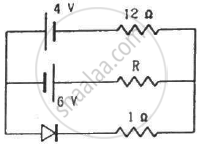
(Assume that the resistance of each diode is zero in forward bias and is infinity in reverse bias.)
Advertisements
Solution
(a) When R = 12 Ω:
The 4 V battery is forward biassing the diode and the 6 V battery is reverse biassing the diode, so the diode is effectively reverse biassed. It acts like an open circuit so that no current flows through this branch. Hence, to simplify the circuit, this branch can be removed.
The current through R on applying the KVL in the circuit is given by
\[i = \frac{10}{24} = 0 . 4166 = 0 . 42 \]A
(b) Similarly, for R = 48 Ω,
\[i = \frac{10}{48 + 12} = \frac{10}{60} = 0 . 16 \] A
APPEARS IN
RELATED QUESTIONS
A zener diode is fabricated by heavily doping both p- and n- sides of the junction. Explain, why?
Explain, with the help of a circuit diagram, the working of a photo-diode. Write briefly how it is used to detect the optical signals.
Mention the important considerations required while fabricating a p-n junction diode to be used as a Light Emitting Diode (LED). What should be the order of band gap of an LED if it is required to emit light in the visible range?
The drift current in a p-n junction is
Two identical p-n junction may be connected in series with a battery in three ways. The potential difference across the two p-n junctions are equal in

The current−voltage characteristic of an ideal p-n junction diode is given by \[i = i_0 ( e^{eV/KT} - 1)\] where, the drift current i0 equals 10 µA. Take the temperature T to be 300 K. (a) Find the voltage V0 for which \[e^{eV/kT} = 100 .\]One can neglect the term 1 for voltages greater than this value. (b) Find an expression for the dynamic resistance of the diode as a function of V for V > V0. (c) Find the voltage for which the dynamic resistance is 0.2 Ω.
(Use Planck constant h = 4.14 × 10⁻¹⁵ eV-s, Boltzmann constant k = 8·62 × 10-5 eV/K.)
A load resistor of 2kΩ is connected in the collector branch of an amplifier circuit using a transistor in common-emitter mode. The current gain β = 50. The input resistance of the transistor is 0.50 kΩ. If the input current is changed by 50µA. (a) by what amount does the output voltage change, (b) by what amount does the input voltage change and (c) what is the power gain?
A diode, a resistor and a 50 Hz AC source are connected in series. The number of current pulses per second through the resistor is __________ .
Answer in detail.
Discuss the effect of external voltage on the width of depletion region of a p-n junction.
p-n junction diode is formed
The formation of the depletion region in a p-n junction diode is due to ______.
What is barrier potential?
What is a p-n junction diode?
Which charge carriers remain near the junction after the region loses mobile charge carriers?
In which circuits are diodes used for signal detection?
Which semiconductor devices use the p-n junction principle?
What is the approximate knee voltage for germanium?
What is the approximate knee voltage for silicon?
Which formula gives the dynamic resistance of a diode?
