Advertisements
Advertisements
Question
During the formation of a p-n junction ______.
Options
diffusion current keeps increasing.
drift current remains constant.
both the diffusion current and drift current remain constant.
diffusion current remains almost constant but the drift current increases till both currents become equal.
Advertisements
Solution
During the formation of a p-n junction diffusion current remains almost constant but the drift current increases till both currents become equal.
RELATED QUESTIONS
Explain briefly with the help of necessary diagrams, the forward biasing of a p-n junction diode. Also draw characteristic curves.
How is a zener diode fabricated so as to make it a special purpose diode? Draw I-V characteristics of zener diode and explain the significance of breakdown voltage.
Explain briefly, with the help of a circuit diagram, how a p-n junction diode works as a half wave rectifier.
If the two ends of a p-n junction are joined by a wire,
The potential barrier existing across an unbiased p-n junction is 0.2 volt. What minimum kinetic energy a hole should have to diffuse from the p-side to the n-side if (a) the junction is unbiased, (b) the junction is forward-biased at 0.1 volt and (c) the junction is reverse-biased at 0.1 volt?
In a p-n junction, a potential barrier of 250 meV exists across the junction. A hole with a kinetic energy of 300 meV approaches the junction. Find the kinetic energy of the hole when it crosses the junction if the hole approached the junction (a) from the p-side and (b) from the n-side.
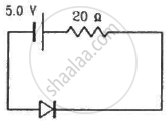
Calculate the current through the circuit and the potential difference across the diode shown in figure. The drift current for the diode is 20 µA.
If in a p-n junction diode, a square input signal of 10 V is applied as shown Then the output signal across RL will be ______

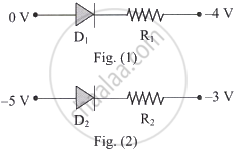
Diode and resistance are connected as shown in figure. Out of the following statements which one is TRUE?
What is barrier potential?
What is drift?
