Advertisements
Advertisements
Question
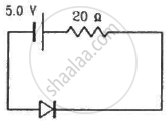
Calculate the current through the circuit and the potential difference across the diode shown in figure. The drift current for the diode is 20 µA.
Advertisements
Solution
(a) From the circuit diagram, it can be said that the diode is reverse biassed, with applied voltage of 5.0 V.
Under reverse bias condition,
Current in the circuit = Drift current
So, the current in the circuit is 20 µA.
(b) Voltage across the diode will be equal to the voltage of the battery minus the voltage drop across the 20 ohm resistor.
\[\Rightarrow V = 5 - iR\]
\[ \Rightarrow V = 5 - (20 \times 20 \times {10}^{- 6} )\]
\[ \Rightarrow V = 5 - (4 \times {10}^{- 4} )\]
\[ \Rightarrow V = {10}^{- 4} (50000 - 4)\]
\[ \Rightarrow V = 49996 \times {10}^{- 4} \]
\[ \Rightarrow V = 4 . 9996 V \cong 5\] V
APPEARS IN
RELATED QUESTIONS
Explain briefly with the help of necessary diagrams, the forward biasing of a p-n junction diode. Also draw characteristic curves.
Explain, with the help of a circuit diagram, the working of a photo-diode. Write briefly how it is used to detect the optical signals.
Explain, with the help of a circuit diagram, the working of n-p-n transistor as a common emitter amplifier.
If the two ends of a p-n junction are joined by a wire,
Diffusion current in a p-n junction is greater than the drift current in magnitude
The drift current in a p-n junction is 20.0 µA. Estimate the number of electrons crossing a cross section per second in the depletion region.
Consider a p-n junction diode having the characteristic \[i - i_0 ( e^{eV/kT} - 1) \text{ where } i_0 = 20\mu A\] . The diode is operated at T = 300 K . (a) Find the current through the diode when a voltage of 300 mV is applied across it in forward bias. (b) At what voltage does the current double?
What are the readings of the ammeters A1 and A2 shown in figure. Neglect the resistance of the meters.
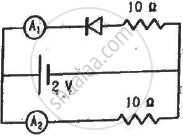
(Assume that the resistance of each diode is zero in forward bias and is infinity in reverse bias.)
Find the current through the battery in each of the circuits shown in figure.
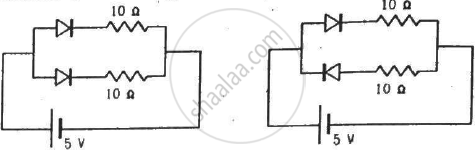
(Assume that the resistance of each diode is zero in forward bias and is infinity in reverse bias.)
The depletion layer in the p-n junction diode is caused by ______.
In a semiconductor diode, the barrier potential offers opposition to only ______.
During the formation of a p-n junction ______.
In p-n junction diode ______.
Which process moves charge carriers from a higher concentration to a lower concentration?
What is static resistance?
Why does microscopic roughness prevent a proper crystal lattice from forming between separate p-type and n-type slabs?
In which circuits are diodes used for signal detection?
Which formula gives the static resistance of a diode?
