Advertisements
Advertisements
Question
An AC source is connected to a diode and a resistor in series. Is the current thorough the resistor AC or DC?
Advertisements
Solution
If the diode and resistor are in series, for the positive half cycle of AC, the current through the resistor will be DC. But for the next half cycle the current through the resistor will be zero. As a diode is a device that converts AC into DC, current through the resistor will be DC.
APPEARS IN
RELATED QUESTIONS
Explain briefly with the help of necessary diagrams, the reverse biasing of a p-n junction diode. Also draw characteristic curves.
Explain, with the help of a circuit diagram, the working of a photo-diode. Write briefly how it is used to detect the optical signals.
Mention the important considerations required while fabricating a p-n junction diode to be used as a Light Emitting Diode (LED). What should be the order of band gap of an LED if it is required to emit light in the visible range?
When a p-type impurity is doped in a semiconductor, a large number of holes are created, This does not make the semiconductor charged. But when holes diffuse from the p-side to the n-side in a p-n junction, the n-side gets positively charged. Explain.
The drift current in a reverse-biased p-n junction is increased in magnitude if the temperature of the junction is increased. Explain this on the basis of creation of hole-electron pairs.
If the two ends of a p-n junction are joined by a wire,
In a p-n junction with open ends,
(a) there is no systematic motion of charge carries
(b) holes and conduction electrons systematically go from the p-side to n-side and from the n-side to p-side respectively
(c) there is no net charge transfer between the two sides
(d) there is a constant electric field near the junction.
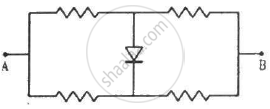
Each of the resistance shown in figure has a value of 20 Ω. Find the equivalent resistance between A and B. Does it depend on whether the point A or B is at higher potential?
What are the readings of the ammeters A1 and A2 shown in figure. Neglect the resistance of the meters.
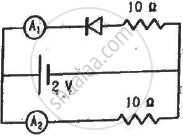
(Assume that the resistance of each diode is zero in forward bias and is infinity in reverse bias.)
A diode, a resistor and a 50 Hz AC source are connected in series. The number of current pulses per second through the resistor is __________ .
Choose the correct option.
Current through a reverse-biased p-n junction increases abruptly at:
The formation of the depletion region in a p-n junction diode is due to ______.
What is the depletion region?
What is a p-n junction diode?
What is dynamic resistance?
How is a true p-n junction created instead of physically joining separate semiconductor pieces?
What role do diodes perform in electronic switching?
Which semiconductor devices use the p-n junction principle?
What is the approximate knee voltage for germanium?
