Advertisements
Advertisements
प्रश्न
An AC source is connected to a diode and a resistor in series. Is the current thorough the resistor AC or DC?
Advertisements
उत्तर
If the diode and resistor are in series, for the positive half cycle of AC, the current through the resistor will be DC. But for the next half cycle the current through the resistor will be zero. As a diode is a device that converts AC into DC, current through the resistor will be DC.
APPEARS IN
संबंधित प्रश्न
Write the two processes that take place in the formation of a p-n junction.
Mention the important considerations required while fabricating a p-n junction diode to be used as a Light Emitting Diode (LED). What should be the order of band gap of an LED if it is required to emit light in the visible range?
How is a zener diode fabricated so as to make it a special purpose diode? Draw I-V characteristics of zener diode and explain the significance of breakdown voltage.
Explain briefly, with the help of a circuit diagram, how a p-n junction diode works as a half wave rectifier.
The drift current in a p-n junction is
Diffusion current in a p-n junction is greater than the drift current in magnitude
The current−voltage characteristic of an ideal p-n junction diode is given by \[i = i_0 ( e^{eV/KT} - 1)\] where, the drift current i0 equals 10 µA. Take the temperature T to be 300 K. (a) Find the voltage V0 for which \[e^{eV/kT} = 100 .\]One can neglect the term 1 for voltages greater than this value. (b) Find an expression for the dynamic resistance of the diode as a function of V for V > V0. (c) Find the voltage for which the dynamic resistance is 0.2 Ω.
(Use Planck constant h = 4.14 × 10⁻¹⁵ eV-s, Boltzmann constant k = 8·62 × 10-5 eV/K.)
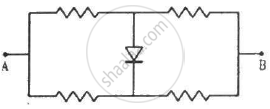
Each of the resistance shown in figure has a value of 20 Ω. Find the equivalent resistance between A and B. Does it depend on whether the point A or B is at higher potential?
Find the current through the resistance R in figure if (a) R = 12Ω (b) R = 48Ω.
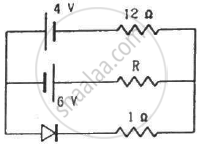
(Assume that the resistance of each diode is zero in forward bias and is infinity in reverse bias.)
When the base current in a transistor is changed from 30µA to 80µA, the collector current is changed from 1.0 mA to 3.5 mA. Find the current gain β.
Choose the correct option.
Current through a reverse-biased p-n junction increases abruptly at:
In a semiconductor diode, the barrier potential offers opposition to only ______.
The formation of the depletion region in a p-n junction diode is due to ______.
In p-n junction diode ______.
Which charge carriers remain near the junction after the region loses mobile charge carriers?
In which direction is the electric field established by the fixed ions?
What role do diodes perform in electronic switching?
Which semiconductor devices use the p-n junction principle?
What is the approximate knee voltage for germanium?
What is the approximate knee voltage for silicon?
