Advertisements
Advertisements
प्रश्न
Mention the important considerations required while fabricating a p-n junction diode to be used as a Light Emitting Diode (LED). What should be the order of band gap of an LED if it is required to emit light in the visible range?
Advertisements
उत्तर
1. The reverse breakdown voltages of LEDs are very low, typically around 5V. So care should be taken while fabricating a pn-junction diode so that the high reverse voltages do not appear across them.
2. There is very little resistance to limit the current in LED. Therefore, a resistor must be used in series with the LED to avoid any damage to it.
The semiconductor used for fabrication of visible LEDs must at least have a band gap of 1.8 eV (spectral range of visible light is from about 0.4 μm to 0.7 μm, i.e., from about 3 eV to 1.8 eV).
APPEARS IN
संबंधित प्रश्न
In an unbiased p-n junction, holes diffuse from the p-region to n-region because ______.
When a p-type impurity is doped in a semiconductor, a large number of holes are created, This does not make the semiconductor charged. But when holes diffuse from the p-side to the n-side in a p-n junction, the n-side gets positively charged. Explain.
Find the current through the resistance R in figure if (a) R = 12Ω (b) R = 48Ω.
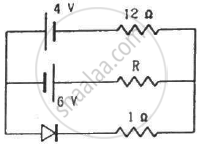
(Assume that the resistance of each diode is zero in forward bias and is infinity in reverse bias.)
Find the equivalent resistance of the network shown in figure between the points A and B.
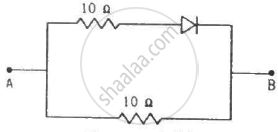
(Assume that the resistance of each diode is zero in forward bias and is infinity in reverse bias.)
If in a p-n junction diode, a square input signal of 10 V is applied as shown Then the output signal across RL will be ______

Zener breakdown occurs in a p-n junction having p and n both:
For an ideal diode, in forward and reverse biased condition the resistance is respectively ______.
Which process moves charge carriers from a higher concentration to a lower concentration?
In which direction is the electric field established by the fixed ions?
What is the use of diodes in power supplies and chargers?
