Advertisements
Advertisements
प्रश्न
In an unbiased p-n junction, holes diffuse from the p-region to n-region because ______.
पर्याय
free electrons in the n-region attract them.
they move across the junction by the potential difference.
hole concentration in p-region is more as compared to n-region.
All the above.
Advertisements
उत्तर
Hole concentration in p-region is more as compared to n-region.
Explanation:
The diffusion of charge carriers across a junction takes place from the region of higher concentration to the region of lower concentration. In this case, the p-region has a greater concentration of holes than the n-region. Hence, in an unbiased p-n junction, holes diffuse from the p-region to the n-region.
संबंधित प्रश्न
A zener diode is fabricated by heavily doping both p- and n- sides of the junction. Explain, why?
Explain briefly with the help of necessary diagrams, the reverse biasing of a p-n junction diode. Also draw characteristic curves.
Mention the important considerations required while fabricating a p-n junction diode to be used as a Light Emitting Diode (LED). What should be the order of band gap of an LED if it is required to emit light in the visible range?
Diffusion current in a p-n junction is greater than the drift current in magnitude
A hole diffuses from the p-side to the n-side in a p-n junction. This means that
When a p-n junction is reverse-biased, the current becomes almost constant at 25 µA. When it is forward-biased at 200 mV, a current of 75 µA is obtained. Find the magnitude of diffusion current when the diode is
(a) unbiased,
(b) reverse-biased at 200 mV and
(c) forward-biased at 200 mV.
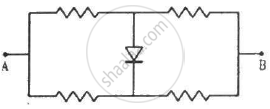
Each of the resistance shown in figure has a value of 20 Ω. Find the equivalent resistance between A and B. Does it depend on whether the point A or B is at higher potential?
What are the readings of the ammeters A1 and A2 shown in figure. Neglect the resistance of the meters.
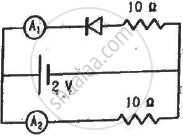
(Assume that the resistance of each diode is zero in forward bias and is infinity in reverse bias.)
Find the current through the battery in each of the circuits shown in figure.
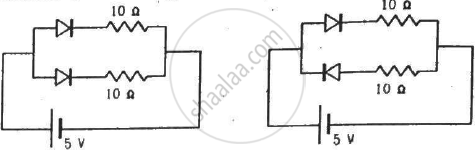
(Assume that the resistance of each diode is zero in forward bias and is infinity in reverse bias.)
Draw the current-voltage characteristics for the device show in figure between the terminals A and B.
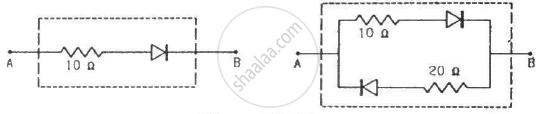
(Assume that the resistance of each diode is zero in forward bias and is infinity in reverse bias.)
Answer in detail.
Discuss the effect of external voltage on the width of depletion region of a p-n junction.
If in a p-n junction diode, a square input signal of 10 V is applied as shown Then the output signal across RL will be ______

For an ideal diode, in forward and reverse biased condition the resistance is respectively ______.
What is a p-n junction diode?
Which process moves charge carriers from a higher concentration to a lower concentration?
What is dynamic resistance?
Which charge carriers remain near the junction after the region loses mobile charge carriers?
What is the approximate knee voltage for silicon?
Which formula gives the dynamic resistance of a diode?
