Advertisements
Advertisements
प्रश्न
A load resistor of 2kΩ is connected in the collector branch of an amplifier circuit using a transistor in common-emitter mode. The current gain β = 50. The input resistance of the transistor is 0.50 kΩ. If the input current is changed by 50µA. (a) by what amount does the output voltage change, (b) by what amount does the input voltage change and (c) what is the power gain?
Advertisements
उत्तर
Given:
Base current gain, \[\beta = 50\]
Change in base current, \[\delta I_b = 50 \mu A\]
Load resistance, \[R_L\] = 2 kΩ
Input resistance, \[R_i\] = 0.50 kΩ
(a) The change in output voltage is given by
\[V_0 = I_c \times R_L \]
\[ \because I_c = \beta \times I_b \]
\[ \therefore V_0 = \beta \times I_b \times R_L \]
\[ \Rightarrow V_0 = 50 \times 50 \mu A \times 2 k\Omega\]
\[ \Rightarrow V_0 = 5 V\]
(b) The change in input voltage is given by
\[\delta V_i = \delta l_b \times R_i \]
\[ \Rightarrow \delta V_i = 50 \times {10}^{- 6} \times 5 \times {10}^2 \]
\[ \Rightarrow \delta V_i = 25 \times {10}^{- 3} \]
\[ \Rightarrow \delta V_i = 25 \text{ mV}\]
(c) Power gain is given by
\[\beta^2 \times \frac{R_L}{R_i}\]
\[ \Rightarrow 2500 \times \frac{2}{0 . 5}\]
\[ \Rightarrow 2500 \times \frac{20}{5} = {10}^4\]
APPEARS IN
संबंधित प्रश्न
A zener diode is fabricated by heavily doping both p- and n- sides of the junction. Explain, why?
A student wants to use two p-n junction diodes to convert alternating current into direct current. Draw the labelled circuit diagram she would use and explain how it works.
Explain, with the help of a circuit diagram, the working of a photo-diode. Write briefly how it is used to detect the optical signals.
Mention the important considerations required while fabricating a p-n junction diode to be used as a Light Emitting Diode (LED). What should be the order of band gap of an LED if it is required to emit light in the visible range?
A hole diffuses from the p-side to the n-side in a p-n junction. This means that
In a p-n junction, a potential barrier of 250 meV exists across the junction. A hole with a kinetic energy of 300 meV approaches the junction. Find the kinetic energy of the hole when it crosses the junction if the hole approached the junction (a) from the p-side and (b) from the n-side.
When a p-n junction is reverse-biased, the current becomes almost constant at 25 µA. When it is forward-biased at 200 mV, a current of 75 µA is obtained. Find the magnitude of diffusion current when the diode is
(a) unbiased,
(b) reverse-biased at 200 mV and
(c) forward-biased at 200 mV.
The drift current in a p-n junction is 20.0 µA. Estimate the number of electrons crossing a cross section per second in the depletion region.
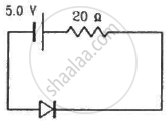
Calculate the current through the circuit and the potential difference across the diode shown in figure. The drift current for the diode is 20 µA.
When the base current in a transistor is changed from 30µA to 80µA, the collector current is changed from 1.0 mA to 3.5 mA. Find the current gain β.
Answer in detail.
Discuss the effect of external voltage on the width of depletion region of a p-n junction.
The depletion layer in the p-n junction diode is caused by ______.
During the formation of a p-n junction ______.
What is barrier potential?
What is a p-n junction diode?
What is static resistance?
What is dynamic resistance?
What is the net current in zero bias when diffusion and drift currents balance?
