Advertisements
Advertisements
प्रश्न
When the base current in a transistor is changed from 30µA to 80µA, the collector current is changed from 1.0 mA to 3.5 mA. Find the current gain β.
Advertisements
उत्तर
Given:
Change in the base current, \[\delta I_b = (80 - 30) \mu \text{A}\]
Change in the collector current, \[\delta I_c = (3 . 5 - 1) \] mA
Thus,
\[\beta = \left( \frac{\delta l_c}{\delta l_b} \right) \text{at constant V}_{cc} \]
\[ \Rightarrow \beta = \frac{2 . 5 \times {10}^{- 3}}{50 \times {10}^{- 6}}\]
\[ \Rightarrow \beta = \frac{250}{50} = 50\]
APPEARS IN
संबंधित प्रश्न
A student wants to use two p-n junction diodes to convert alternating current into direct current. Draw the labelled circuit diagram she would use and explain how it works.
When a p-type impurity is doped in a semiconductor, a large number of holes are created, This does not make the semiconductor charged. But when holes diffuse from the p-side to the n-side in a p-n junction, the n-side gets positively charged. Explain.
If the two ends of a p-n junction are joined by a wire,
The drift current in a p-n junction is
The potential barrier existing across an unbiased p-n junction is 0.2 volt. What minimum kinetic energy a hole should have to diffuse from the p-side to the n-side if (a) the junction is unbiased, (b) the junction is forward-biased at 0.1 volt and (c) the junction is reverse-biased at 0.1 volt?
In a p-n junction, a potential barrier of 250 meV exists across the junction. A hole with a kinetic energy of 300 meV approaches the junction. Find the kinetic energy of the hole when it crosses the junction if the hole approached the junction (a) from the p-side and (b) from the n-side.
The current−voltage characteristic of an ideal p-n junction diode is given by \[i = i_0 ( e^{eV/KT} - 1)\] where, the drift current i0 equals 10 µA. Take the temperature T to be 300 K. (a) Find the voltage V0 for which \[e^{eV/kT} = 100 .\]One can neglect the term 1 for voltages greater than this value. (b) Find an expression for the dynamic resistance of the diode as a function of V for V > V0. (c) Find the voltage for which the dynamic resistance is 0.2 Ω.
(Use Planck constant h = 4.14 × 10⁻¹⁵ eV-s, Boltzmann constant k = 8·62 × 10-5 eV/K.)
Find the current through the battery in each of the circuits shown in figure.
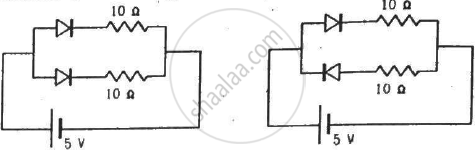
(Assume that the resistance of each diode is zero in forward bias and is infinity in reverse bias.)
Draw the current-voltage characteristics for the device show in figure between the terminals A and B.
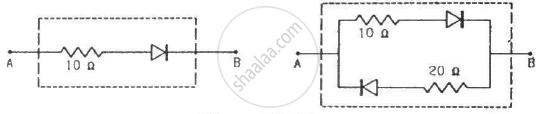
(Assume that the resistance of each diode is zero in forward bias and is infinity in reverse bias.)
Find the equivalent resistance of the network shown in figure between the points A and B.
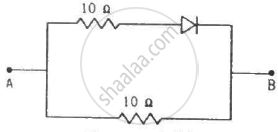
(Assume that the resistance of each diode is zero in forward bias and is infinity in reverse bias.)
The depletion layer in the p-n junction diode is caused by ______.
Zener breakdown occurs in a p-n junction having p and n both:
During the formation of a p-n junction ______.
What is a p-n junction diode?
What is static resistance?
Why does microscopic roughness prevent a proper crystal lattice from forming between separate p-type and n-type slabs?
In which circuits are diodes used for signal detection?
What is the net current in zero bias when diffusion and drift currents balance?
Which formula gives the static resistance of a diode?
