Advertisements
Advertisements
प्रश्न
The drift current in a p-n junction is 20.0 µA. Estimate the number of electrons crossing a cross section per second in the depletion region.
Advertisements
उत्तर
Given:
Drift current, id = 20 µA = 20 × 10−6 A
Both holes and electrons are moving and contributing to the current flow.
We know that current is the rate of the flow of charge.
Thus, we need to find the number of electrons crossing unit area per second.
Now,
t = 1 s
\[i_d = \frac{Q}{T}\]
\[ \because T = 1 \]s
\[ \therefore i_d = Q = \]ne
\[ \Rightarrow n = \frac{i_d}{e}\]
So, the total number of charge carriers crossing the depletion region is given by
\[n = \frac{20 \times {10}^{- 6}}{2 \times 1 . 6 \times {10}^{- 19}}\]
\[ \Rightarrow n = 6 . 25 \times {10}^{13}\]
Also, the number of electrons crossing the depletion region is given by
\[n_e = \frac{n}{2} = \frac{6 . 25 \times {10}^{13}}{2}\]
\[ \Rightarrow n_e = 3 . 1 \times {10}^{13}\]
APPEARS IN
संबंधित प्रश्न
In an unbiased p-n junction, holes diffuse from the p-region to n-region because ______.
Explain briefly with the help of necessary diagrams, the forward biasing of a p-n junction diode. Also draw characteristic curves.
Explain, with the help of a circuit diagram, the working of a photo-diode. Write briefly how it is used to detect the optical signals.
Draw a circuit diagram to study the input and output characteristics of an n-p-n transistor in its common emitter configuration. Draw the typical input and output characteristics.
Explain, with the help of a circuit diagram, the working of n-p-n transistor as a common emitter amplifier.
The diffusion current in a p-n junction is
Diffusion current in a p-n junction is greater than the drift current in magnitude
A hole diffuses from the p-side to the n-side in a p-n junction. This means that
When a p-n junction is reverse-biased, the current becomes almost constant at 25 µA. When it is forward-biased at 200 mV, a current of 75 µA is obtained. Find the magnitude of diffusion current when the diode is
(a) unbiased,
(b) reverse-biased at 200 mV and
(c) forward-biased at 200 mV.
What are the readings of the ammeters A1 and A2 shown in figure. Neglect the resistance of the meters.
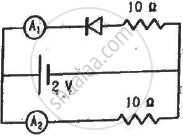
(Assume that the resistance of each diode is zero in forward bias and is infinity in reverse bias.)
Find the current through the resistance R in figure if (a) R = 12Ω (b) R = 48Ω.
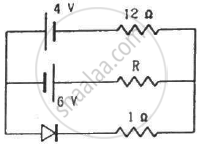
(Assume that the resistance of each diode is zero in forward bias and is infinity in reverse bias.)
When the base current in a transistor is changed from 30µA to 80µA, the collector current is changed from 1.0 mA to 3.5 mA. Find the current gain β.
Answer in detail.
Discuss the effect of external voltage on the width of depletion region of a p-n junction.
If in a p-n junction diode, a square input signal of 10 V is applied as shown Then the output signal across RL will be ______

p-n junction diode is formed
The formation of the depletion region in a p-n junction diode is due to ______.
In p-n junction diode ______.
