Advertisements
Advertisements
Question
The drift current in a p-n junction is 20.0 µA. Estimate the number of electrons crossing a cross section per second in the depletion region.
Advertisements
Solution
Given:
Drift current, id = 20 µA = 20 × 10−6 A
Both holes and electrons are moving and contributing to the current flow.
We know that current is the rate of the flow of charge.
Thus, we need to find the number of electrons crossing unit area per second.
Now,
t = 1 s
\[i_d = \frac{Q}{T}\]
\[ \because T = 1 \]s
\[ \therefore i_d = Q = \]ne
\[ \Rightarrow n = \frac{i_d}{e}\]
So, the total number of charge carriers crossing the depletion region is given by
\[n = \frac{20 \times {10}^{- 6}}{2 \times 1 . 6 \times {10}^{- 19}}\]
\[ \Rightarrow n = 6 . 25 \times {10}^{13}\]
Also, the number of electrons crossing the depletion region is given by
\[n_e = \frac{n}{2} = \frac{6 . 25 \times {10}^{13}}{2}\]
\[ \Rightarrow n_e = 3 . 1 \times {10}^{13}\]
APPEARS IN
RELATED QUESTIONS
Write the two processes that take place in the formation of a p-n junction.
Explain, with the help of a circuit diagram, the working of a photo-diode. Write briefly how it is used to detect the optical signals.
When a p-type impurity is doped in a semiconductor, a large number of holes are created, This does not make the semiconductor charged. But when holes diffuse from the p-side to the n-side in a p-n junction, the n-side gets positively charged. Explain.
A semiconducting device is connected in a series circuit with a battery and a resistance. A current is found to pass through the circuit. If the polarity of the battery is reversed, the current drops to almost zero. the device may be
(a) an intrinsic semiconductor
(b) a p-type semiconductor
(c) an n-type semiconductor
(d) a p-n junction
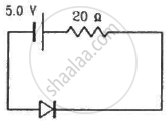
Calculate the current through the circuit and the potential difference across the diode shown in figure. The drift current for the diode is 20 µA.
Draw the current-voltage characteristics for the device show in figure between the terminals A and B.
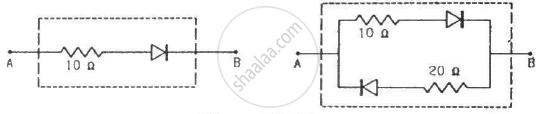
(Assume that the resistance of each diode is zero in forward bias and is infinity in reverse bias.)
Answer in detail.
Discuss the effect of external voltage on the width of depletion region of a p-n junction.
If in a p-n junction diode, a square input signal of 10 V is applied as shown Then the output signal across RL will be ______

The depletion layer in the p-n junction diode is caused by ______.
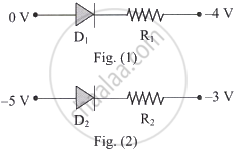
Diode and resistance are connected as shown in figure. Out of the following statements which one is TRUE?
What is barrier potential?
What is static resistance?
When p-type and n-type regions are formed in a single crystal, which carriers initially diffuse from each side?
Which charge carriers remain near the junction after the region loses mobile charge carriers?
What is the use of diodes in power supplies and chargers?
In which circuits are diodes used for signal detection?
Which semiconductor devices use the p-n junction principle?
What is the approximate knee voltage for silicon?
