Advertisements
Advertisements
Question
In a p.n junction, the depletion region is 400 nm wide and an electric field of 5 × 10⁵ V m−1 exists in it. (a) Find the height of the potential barrier. (b) What should be the minimum kinetic energy of a conduction electron which can diffuse from the n-side to the p-side?
Advertisements
Solution
Let:
Depletion region width, d = 400 nm = 4 × 10⁻⁷ m
Electric field, E = 5 × 10⁵ Vm−1
(a) Let the potential barrier be V.
The relation between the potential and the electric field is given by V = Ed
\[\Rightarrow\]V = E × d = 5 × d
Energy of any electron accelerated through a potential of V = eV
Also, the minimum energy of the electron should be equal to the band gap of the material.
∴ Potential barrier × e = 0.2 eV (e = Charge of the electron)
APPEARS IN
RELATED QUESTIONS
In a p-n junction diode, the current I can be expressed as
I = `"I"_0 exp ("eV"/(2"k"_"BT") - 1)`
where I0 is called the reverse saturation current, V is the voltage across the diode and is positive for forward bias and negative for reverse bias, and I is the current through the diode, kBis the Boltzmann constant (8.6×10⁻⁵ eV/K) and T is the absolute temperature. If for a given diode I0 = 5 × 10⁻¹² A and T = 300 K, then
(a) What will be the forward current at a forward voltage of 0.6 V?
(b) What will be the increase in the current if the voltage across the diode is increased to 0.7 V?
(c) What is the dynamic resistance?
(d) What will be the current if reverse bias voltage changes from 1 V to 2 V?
Write the two processes that take place in the formation of a p-n junction.
A zener diode is fabricated by heavily doping both p- and n- sides of the junction. Explain, why?
A student wants to use two p-n junction diodes to convert alternating current into direct current. Draw the labelled circuit diagram she would use and explain how it works.
The diffusion current in a p-n junction is
The drift current in a p-n junction is 20.0 µA. Estimate the number of electrons crossing a cross section per second in the depletion region.
Find the equivalent resistance of the network shown in figure between the points A and B.
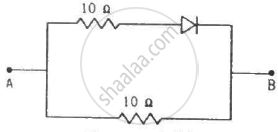
(Assume that the resistance of each diode is zero in forward bias and is infinity in reverse bias.)
When the base current in a transistor is changed from 30µA to 80µA, the collector current is changed from 1.0 mA to 3.5 mA. Find the current gain β.
An AC source is connected to a diode and a resistor in series. Is the current thorough the resistor AC or DC?
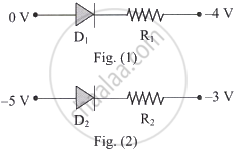
Diode and resistance are connected as shown in figure. Out of the following statements which one is TRUE?
What is barrier potential?
Which process moves charge carriers from a higher concentration to a lower concentration?
What is static resistance?
What is dynamic resistance?
Which charge carriers remain near the junction after the region loses mobile charge carriers?
In which direction is the electric field established by the fixed ions?
In which circuits are diodes used for signal detection?
Which semiconductor devices use the p-n junction principle?
Which formula gives the dynamic resistance of a diode?
