Advertisements
Advertisements
प्रश्न
In a p.n junction, the depletion region is 400 nm wide and an electric field of 5 × 10⁵ V m−1 exists in it. (a) Find the height of the potential barrier. (b) What should be the minimum kinetic energy of a conduction electron which can diffuse from the n-side to the p-side?
Advertisements
उत्तर
Let:
Depletion region width, d = 400 nm = 4 × 10⁻⁷ m
Electric field, E = 5 × 10⁵ Vm−1
(a) Let the potential barrier be V.
The relation between the potential and the electric field is given by V = Ed
\[\Rightarrow\]V = E × d = 5 × d
Energy of any electron accelerated through a potential of V = eV
Also, the minimum energy of the electron should be equal to the band gap of the material.
∴ Potential barrier × e = 0.2 eV (e = Charge of the electron)
APPEARS IN
संबंधित प्रश्न
Write the two processes that take place in the formation of a p-n junction.
A zener diode is fabricated by heavily doping both p- and n- sides of the junction. Explain, why?
Explain, with the help of a circuit diagram, the working of n-p-n transistor as a common emitter amplifier.
When a p-type impurity is doped in a semiconductor, a large number of holes are created, This does not make the semiconductor charged. But when holes diffuse from the p-side to the n-side in a p-n junction, the n-side gets positively charged. Explain.
The drift current in a reverse-biased p-n junction is increased in magnitude if the temperature of the junction is increased. Explain this on the basis of creation of hole-electron pairs.
The drift current in a p-n junction is
In a p-n junction,
(a) new holes and conduction electrons are produced continuously throughout the material
(b) new holes and conduction electrons are produced continuously throughout the material except in the depletion region
(c) holes and conduction electrons recombine continuously throughout the material
(d) holes and conduction electrons recombine continuously throughout the material except in the depletion region.
A semiconducting device is connected in a series circuit with a battery and a resistance. A current is found to pass through the circuit. If the polarity of the battery is reversed, the current drops to almost zero. the device may be
(a) an intrinsic semiconductor
(b) a p-type semiconductor
(c) an n-type semiconductor
(d) a p-n junction
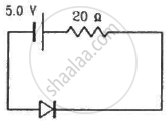
Calculate the current through the circuit and the potential difference across the diode shown in figure. The drift current for the diode is 20 µA.
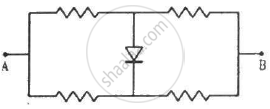
Each of the resistance shown in figure has a value of 20 Ω. Find the equivalent resistance between A and B. Does it depend on whether the point A or B is at higher potential?
The depletion layer in the p-n junction diode is caused by ______.
During the formation of a p-n junction ______.
For an ideal diode, in forward and reverse biased condition the resistance is respectively ______.
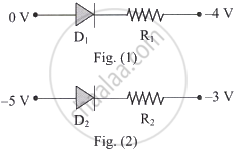
Diode and resistance are connected as shown in figure. Out of the following statements which one is TRUE?
What is dynamic resistance?
When p-type and n-type regions are formed in a single crystal, which carriers initially diffuse from each side?
Which charge carriers remain near the junction after the region loses mobile charge carriers?
In which direction is the electric field established by the fixed ions?
Which semiconductor devices use the p-n junction principle?
What is the approximate knee voltage for silicon?
