Advertisements
Advertisements
प्रश्न
Find the currents through the resistance in the circuits shown in figure.
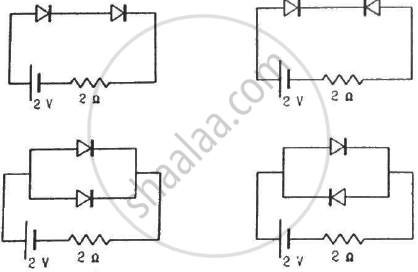
(Assume that the resistance of each diode is zero in forward bias and is infinity in reverse bias.)
Advertisements
उत्तर
We know that under forward bias, an ideal diode acts as a short circuit; and under reverse bias, an ideal diode acts as an open circuit.
(a) Since both the diodes are forward biassed, they can be replaced by short circuits.
Net resistance = 2 Ω
\[i = \frac{2 V}{2 \Omega} = 1 A\]
(b) One diode is forward biassed and the other is reverse biassed; thus, the resistance of one becomes ∞. The circuit becomes open at the position of the second diode, so no current flows through this arm.
\[\therefore i = \frac{2}{2 + \infty} = 0 A\]
(c) Both of them are forward biassed. Thus, the resistance is zero.
We can replace both the resistors by short circuits.
Net resistance = 2 Ω
\[\therefore i = \frac{2}{2} = 1 A\]
(d) One of them is forward biassed and the other is reverse biassed.
Thus, the current passes through the forward-biassed diode and the other acts as open circuit.
\[\therefore i = \frac{2}{2} = 1 A\]
APPEARS IN
संबंधित प्रश्न
Explain, with the help of a circuit diagram, the working of a photo-diode. Write briefly how it is used to detect the optical signals.
Draw a circuit diagram to study the input and output characteristics of an n-p-n transistor in its common emitter configuration. Draw the typical input and output characteristics.
Explain, with the help of a circuit diagram, the working of n-p-n transistor as a common emitter amplifier.
If the two ends of a p-n junction are joined by a wire,
Diffusion current in a p-n junction is greater than the drift current in magnitude
In a p-n junction, a potential barrier of 250 meV exists across the junction. A hole with a kinetic energy of 300 meV approaches the junction. Find the kinetic energy of the hole when it crosses the junction if the hole approached the junction (a) from the p-side and (b) from the n-side.
What are the readings of the ammeters A1 and A2 shown in figure. Neglect the resistance of the meters.
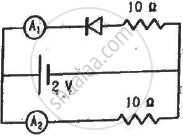
(Assume that the resistance of each diode is zero in forward bias and is infinity in reverse bias.)
A load resistor of 2kΩ is connected in the collector branch of an amplifier circuit using a transistor in common-emitter mode. The current gain β = 50. The input resistance of the transistor is 0.50 kΩ. If the input current is changed by 50µA. (a) by what amount does the output voltage change, (b) by what amount does the input voltage change and (c) what is the power gain?
The depletion layer in the p-n junction diode is caused by ______.
The formation of the depletion region in a p-n junction diode is due to ______.
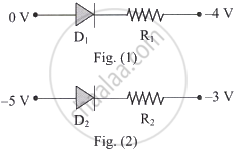
Diode and resistance are connected as shown in figure. Out of the following statements which one is TRUE?
What is static resistance?
In which direction is the electric field established by the fixed ions?
How is a true p-n junction created instead of physically joining separate semiconductor pieces?
What role do diodes perform in electronic switching?
What is the net current in zero bias when diffusion and drift currents balance?
What is the approximate knee voltage for silicon?
