Advertisements
Advertisements
प्रश्न
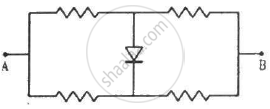
Each of the resistance shown in figure has a value of 20 Ω. Find the equivalent resistance between A and B. Does it depend on whether the point A or B is at higher potential?
Advertisements
उत्तर
According to the Wheatstone bridge principle, if the bridge is balanced, then the current flow across the central resistor is zero. So, to simplify the circuit, we can remove the central resistor.
The given circuit is also balanced, so there is no current through the diode.
Hence, the net resistance of the circuit is given by
\[R_P = \frac{R_1 R_2}{R_1 + R_2}\]
\[\text{For } R_1 = R_2 = R, \]
\[ R_P = \frac{R}{2} = \frac{40}{2}\]
\[ \Rightarrow R_P = 20 \Omega\]
APPEARS IN
संबंधित प्रश्न
Mention the important considerations required while fabricating a p-n junction diode to be used as a Light Emitting Diode (LED). What should be the order of band gap of an LED if it is required to emit light in the visible range?
Explain, with the help of a circuit diagram, the working of n-p-n transistor as a common emitter amplifier.
The drift current in a p-n junction is
Two identical p-n junction may be connected in series with a battery in three ways. The potential difference across the two p-n junctions are equal in

In a p-n junction,
(a) new holes and conduction electrons are produced continuously throughout the material
(b) new holes and conduction electrons are produced continuously throughout the material except in the depletion region
(c) holes and conduction electrons recombine continuously throughout the material
(d) holes and conduction electrons recombine continuously throughout the material except in the depletion region.
When a p-n junction is reverse-biased, the current becomes almost constant at 25 µA. When it is forward-biased at 200 mV, a current of 75 µA is obtained. Find the magnitude of diffusion current when the diode is
(a) unbiased,
(b) reverse-biased at 200 mV and
(c) forward-biased at 200 mV.
The drift current in a p-n junction is 20.0 µA. Estimate the number of electrons crossing a cross section per second in the depletion region.
When the base current in a transistor is changed from 30µA to 80µA, the collector current is changed from 1.0 mA to 3.5 mA. Find the current gain β.
An AC source is connected to a diode and a resistor in series. Is the current thorough the resistor AC or DC?
In a semiconductor diode, the barrier potential offers opposition to only ______.
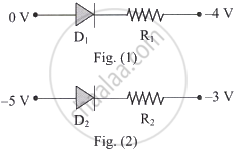
Diode and resistance are connected as shown in figure. Out of the following statements which one is TRUE?
What is the depletion region?
What is a p-n junction diode?
Which process moves charge carriers from a higher concentration to a lower concentration?
What is drift?
When p-type and n-type regions are formed in a single crystal, which carriers initially diffuse from each side?
Why does microscopic roughness prevent a proper crystal lattice from forming between separate p-type and n-type slabs?
How is a true p-n junction created instead of physically joining separate semiconductor pieces?
Which formula gives the dynamic resistance of a diode?
