Advertisements
Advertisements
प्रश्न
The formation of the depletion region in a p-n junction diode is due to ______.
विकल्प
movement of dopant atoms
diffusion of both electrons and holes
drift of electrons only
the drift of holes only
Advertisements
उत्तर
The formation of the depletion region in a p-n junction diode is due to the diffusion of both electrons and holes.
Explanation:
Charge diffusion is what creates the depletion area. holes diffuse across the junction from the p-side to the n-side due to the concentration gradient, whereas electrons diffuse from the n-side to the p-side. Near the junction, the holes and the electrons that are diffusely moving in the same direction unite.
APPEARS IN
संबंधित प्रश्न
Diffusion current in a p-n junction is greater than the drift current in magnitude
A hole diffuses from the p-side to the n-side in a p-n junction. This means that
In a p.n junction, the depletion region is 400 nm wide and an electric field of 5 × 10⁵ V m−1 exists in it. (a) Find the height of the potential barrier. (b) What should be the minimum kinetic energy of a conduction electron which can diffuse from the n-side to the p-side?
In a p-n junction, a potential barrier of 250 meV exists across the junction. A hole with a kinetic energy of 300 meV approaches the junction. Find the kinetic energy of the hole when it crosses the junction if the hole approached the junction (a) from the p-side and (b) from the n-side.
When a p-n junction is reverse-biased, the current becomes almost constant at 25 µA. When it is forward-biased at 200 mV, a current of 75 µA is obtained. Find the magnitude of diffusion current when the diode is
(a) unbiased,
(b) reverse-biased at 200 mV and
(c) forward-biased at 200 mV.
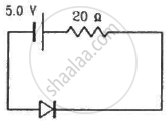
Calculate the current through the circuit and the potential difference across the diode shown in figure. The drift current for the diode is 20 µA.
Find the currents through the resistance in the circuits shown in figure.
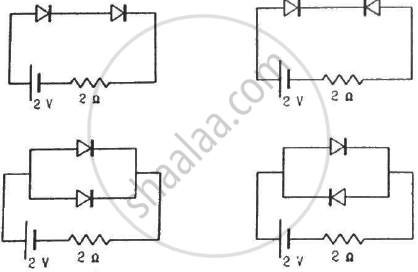
(Assume that the resistance of each diode is zero in forward bias and is infinity in reverse bias.)
A diode, a resistor and a 50 Hz AC source are connected in series. The number of current pulses per second through the resistor is __________ .
What is the depletion region?
What is the use of diodes in power supplies and chargers?
