Advertisements
Advertisements
प्रश्न
Find the current through the resistance R in figure if (a) R = 12Ω (b) R = 48Ω.
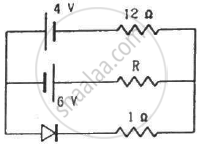
(Assume that the resistance of each diode is zero in forward bias and is infinity in reverse bias.)
Advertisements
उत्तर
(a) When R = 12 Ω:
The 4 V battery is forward biassing the diode and the 6 V battery is reverse biassing the diode, so the diode is effectively reverse biassed. It acts like an open circuit so that no current flows through this branch. Hence, to simplify the circuit, this branch can be removed.
The current through R on applying the KVL in the circuit is given by
\[i = \frac{10}{24} = 0 . 4166 = 0 . 42 \]A
(b) Similarly, for R = 48 Ω,
\[i = \frac{10}{48 + 12} = \frac{10}{60} = 0 . 16 \] A
APPEARS IN
संबंधित प्रश्न
In an unbiased p-n junction, holes diffuse from the p-region to n-region because ______.
Write the two processes that take place in the formation of a p-n junction.
A student wants to use two p-n junction diodes to convert alternating current into direct current. Draw the labelled circuit diagram she would use and explain how it works.
Explain, with the help of a circuit diagram, the working of a photo-diode. Write briefly how it is used to detect the optical signals.
Mention the important considerations required while fabricating a p-n junction diode to be used as a Light Emitting Diode (LED). What should be the order of band gap of an LED if it is required to emit light in the visible range?
Explain, with the help of a circuit diagram, the working of n-p-n transistor as a common emitter amplifier.
How is a zener diode fabricated so as to make it a special purpose diode? Draw I-V characteristics of zener diode and explain the significance of breakdown voltage.
Explain briefly, with the help of a circuit diagram, how a p-n junction diode works as a half wave rectifier.
The drift current in a p-n junction is
A hole diffuses from the p-side to the n-side in a p-n junction. This means that
A semiconducting device is connected in a series circuit with a battery and a resistance. A current is found to pass through the circuit. If the polarity of the battery is reversed, the current drops to almost zero. the device may be
(a) an intrinsic semiconductor
(b) a p-type semiconductor
(c) an n-type semiconductor
(d) a p-n junction
The drift current in a p-n junction is 20.0 µA. Estimate the number of electrons crossing a cross section per second in the depletion region.
The current−voltage characteristic of an ideal p-n junction diode is given by \[i = i_0 ( e^{eV/KT} - 1)\] where, the drift current i0 equals 10 µA. Take the temperature T to be 300 K. (a) Find the voltage V0 for which \[e^{eV/kT} = 100 .\]One can neglect the term 1 for voltages greater than this value. (b) Find an expression for the dynamic resistance of the diode as a function of V for V > V0. (c) Find the voltage for which the dynamic resistance is 0.2 Ω.
(Use Planck constant h = 4.14 × 10⁻¹⁵ eV-s, Boltzmann constant k = 8·62 × 10-5 eV/K.)
An AC source is connected to a diode and a resistor in series. Is the current thorough the resistor AC or DC?
The depletion layer in the p-n junction diode is caused by ______.
What is dynamic resistance?
When p-type and n-type regions are formed in a single crystal, which carriers initially diffuse from each side?
How is a true p-n junction created instead of physically joining separate semiconductor pieces?
In which circuits are diodes used for signal detection?
