Advertisements
Advertisements
प्रश्न
An AC source is connected to a diode and a resistor in series. Is the current thorough the resistor AC or DC?
Advertisements
उत्तर
If the diode and resistor are in series, for the positive half cycle of AC, the current through the resistor will be DC. But for the next half cycle the current through the resistor will be zero. As a diode is a device that converts AC into DC, current through the resistor will be DC.
APPEARS IN
संबंधित प्रश्न
Explain briefly with the help of necessary diagrams, the reverse biasing of a p-n junction diode. Also draw characteristic curves.
A student wants to use two p-n junction diodes to convert alternating current into direct current. Draw the labelled circuit diagram she would use and explain how it works.
How is a zener diode fabricated so as to make it a special purpose diode? Draw I-V characteristics of zener diode and explain the significance of breakdown voltage.
Explain briefly, with the help of a circuit diagram, how a p-n junction diode works as a half wave rectifier.
Two identical p-n junction may be connected in series with a battery in three ways. The potential difference across the two p-n junctions are equal in

In a p-n junction,
(a) new holes and conduction electrons are produced continuously throughout the material
(b) new holes and conduction electrons are produced continuously throughout the material except in the depletion region
(c) holes and conduction electrons recombine continuously throughout the material
(d) holes and conduction electrons recombine continuously throughout the material except in the depletion region.
A semiconducting device is connected in a series circuit with a battery and a resistance. A current is found to pass through the circuit. If the polarity of the battery is reversed, the current drops to almost zero. the device may be
(a) an intrinsic semiconductor
(b) a p-type semiconductor
(c) an n-type semiconductor
(d) a p-n junction
Draw the current-voltage characteristics for the device show in figure between the terminals A and B.
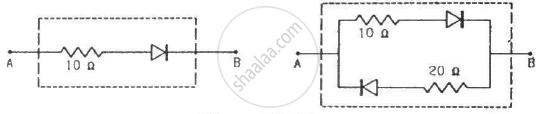
(Assume that the resistance of each diode is zero in forward bias and is infinity in reverse bias.)
A load resistor of 2kΩ is connected in the collector branch of an amplifier circuit using a transistor in common-emitter mode. The current gain β = 50. The input resistance of the transistor is 0.50 kΩ. If the input current is changed by 50µA. (a) by what amount does the output voltage change, (b) by what amount does the input voltage change and (c) what is the power gain?
Answer in detail.
Discuss the effect of external voltage on the width of depletion region of a p-n junction.
The depletion layer in the p-n junction diode is caused by ______.
Zener breakdown occurs in a p-n junction having p and n both:
For an ideal diode, in forward and reverse biased condition the resistance is respectively ______.
How does the interface between physically joined p-type and n-type slabs act on charge carriers?
What is the use of diodes in power supplies and chargers?
What role do diodes perform in electronic switching?
Which semiconductor devices use the p-n junction principle?
What is the net current in zero bias when diffusion and drift currents balance?
Which formula gives the static resistance of a diode?
Which formula gives the dynamic resistance of a diode?
