Advertisements
Advertisements
प्रश्न
The current−voltage characteristic of an ideal p-n junction diode is given by \[i = i_0 ( e^{eV/KT} - 1)\] where, the drift current i0 equals 10 µA. Take the temperature T to be 300 K. (a) Find the voltage V0 for which \[e^{eV/kT} = 100 .\]One can neglect the term 1 for voltages greater than this value. (b) Find an expression for the dynamic resistance of the diode as a function of V for V > V0. (c) Find the voltage for which the dynamic resistance is 0.2 Ω.
(Use Planck constant h = 4.14 × 10⁻¹⁵ eV-s, Boltzmann constant k = 8·62 × 10-5 eV/K.)
Advertisements
उत्तर
(a) The current‒voltage relationship of a diode is given by
\[i = i_0 ( e^{eV/kT - 1} )\]
For a large value of voltage, 1 can be neglected.
\[i \approx i_0 e^{eV/kT}\]
Again, we need to find the voltage at which
\[e^{eV/kT} = 100\]
\[\Rightarrow \frac{eV}{kT} = \text{ln }100\]
\[ \Rightarrow V = \frac{\text{ ln }100 \times \text{ kT }}{e}\]
\[ \Rightarrow V = \frac{2 . 303 \times \log 100 \times 8 . 62 \times {10}^{- 5} \times 300}{e}\]
\[ \Rightarrow V=0.12\] V
(b) Given:-
\[i = i_0 ( e^{eV/kT - 1} ) ...........(1)\]
We know that the dynamic resistance of a diode is the rate of change of voltage w.r.t. current.
i.e.
\[R = \frac{d V}{\text{d i}}\]
As the exponential factor dominates the factor of 1, we can neglect this factor.
Now, on differentiating eq. (1) w.r.t. V, we get
\[\frac{\text{di}}{\text{dV}} = i_0 \frac{e}{kT} e^{eV/kT} \]
\[ \Rightarrow \frac{1}{R} = \frac{e i_0}{kT} e^{eV/kT} \]
\[ \Rightarrow R = \frac{kT}{e i_0} e^{- eV/kT} ............(2)\]
(c) Given:-
R = 2 Ω
On substituting this value in eq. (2), we get
\[2 = \frac{8 . 62 \times {10}^{- 5} \times 300}{e \times 10 \times {10}^{- 6}} e^{- eV/8 . 62 \times {10}^{- 5} \times 300} \]
\[ \Rightarrow V = 0 . 25 \] V
APPEARS IN
संबंधित प्रश्न
Explain, with the help of a circuit diagram, the working of a photo-diode. Write briefly how it is used to detect the optical signals.
Mention the important considerations required while fabricating a p-n junction diode to be used as a Light Emitting Diode (LED). What should be the order of band gap of an LED if it is required to emit light in the visible range?
Draw a circuit diagram to study the input and output characteristics of an n-p-n transistor in its common emitter configuration. Draw the typical input and output characteristics.
Explain, with the help of a circuit diagram, the working of n-p-n transistor as a common emitter amplifier.
How is a zener diode fabricated so as to make it a special purpose diode? Draw I-V characteristics of zener diode and explain the significance of breakdown voltage.
Explain briefly, with the help of a circuit diagram, how a p-n junction diode works as a half wave rectifier.
The drift current in a reverse-biased p-n junction is increased in magnitude if the temperature of the junction is increased. Explain this on the basis of creation of hole-electron pairs.
The drift current in a p-n junction is
In a p-n junction,
(a) new holes and conduction electrons are produced continuously throughout the material
(b) new holes and conduction electrons are produced continuously throughout the material except in the depletion region
(c) holes and conduction electrons recombine continuously throughout the material
(d) holes and conduction electrons recombine continuously throughout the material except in the depletion region.
A semiconducting device is connected in a series circuit with a battery and a resistance. A current is found to pass through the circuit. If the polarity of the battery is reversed, the current drops to almost zero. the device may be
(a) an intrinsic semiconductor
(b) a p-type semiconductor
(c) an n-type semiconductor
(d) a p-n junction
Consider a p-n junction diode having the characteristic \[i - i_0 ( e^{eV/kT} - 1) \text{ where } i_0 = 20\mu A\] . The diode is operated at T = 300 K . (a) Find the current through the diode when a voltage of 300 mV is applied across it in forward bias. (b) At what voltage does the current double?
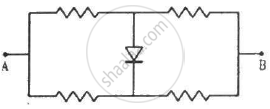
Each of the resistance shown in figure has a value of 20 Ω. Find the equivalent resistance between A and B. Does it depend on whether the point A or B is at higher potential?
Find the currents through the resistance in the circuits shown in figure.
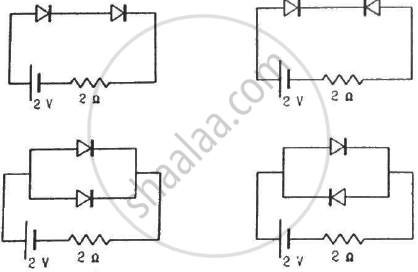
(Assume that the resistance of each diode is zero in forward bias and is infinity in reverse bias.)
What are the readings of the ammeters A1 and A2 shown in figure. Neglect the resistance of the meters.
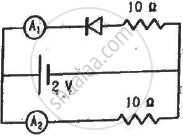
(Assume that the resistance of each diode is zero in forward bias and is infinity in reverse bias.)
Find the current through the resistance R in figure if (a) R = 12Ω (b) R = 48Ω.
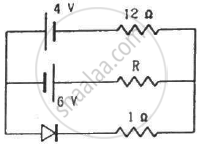
(Assume that the resistance of each diode is zero in forward bias and is infinity in reverse bias.)
Draw the current-voltage characteristics for the device show in figure between the terminals A and B.
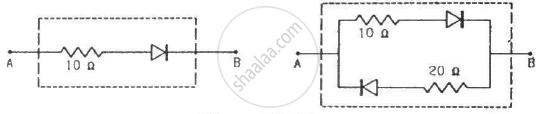
(Assume that the resistance of each diode is zero in forward bias and is infinity in reverse bias.)
If in a p-n junction diode, a square input signal of 10 V is applied as shown Then the output signal across RL will be ______

The depletion layer in the p-n junction diode is caused by ______.
In a semiconductor diode, the barrier potential offers opposition to only ______.
For an ideal diode, in forward and reverse biased condition the resistance is respectively ______.
