Advertisements
Advertisements
प्रश्न
The diffusion current in a p-n junction is
विकल्प
from the n-side ot the p-side
from the p-side to the n-side
from the n-side to the p-side if the junction is forward-biased and in the opposite direction if it is reverse-biased
from the p-side to the n-side if the junction is forward and in the opposite direction if it is reverse-biased.
Advertisements
उत्तर
from the p-side to the n-side
When a p‒n junction is formed then because of the difference in the concentration of charge carriers in the two regions, electrons from the n region move to the p region and holes from the p region move to the n region. Since the direction of the current is always opposite to the motion of electron, the direction of the current is from the p side to the n side.
Similarly, when the junction is forward biassed, the positive terminal of the battery is connected to the p side of the p‒n junction and the negative terminal of the battery is connected to the n side of the p‒n junction. As a result, electrons in the n side of the p‒njunction are repelled by the negative terminal of the battery and they move to the p side, where the positive terminal of the battery attracts them. Similarly, holes from the p side of the p‒n junction are repelled by the positive terminal of the battery and they move to the n side, where the negative terminal of the battery attracts them. Thus, they give diffusion current from the p side to the n side across the p‒n junction.
In reverse biassing, there is no flow of majority carriers across the junction; hence, there is not diffusion current. Here, the flow of majority carriers is opposed by the applied voltage.
APPEARS IN
संबंधित प्रश्न
In an unbiased p-n junction, holes diffuse from the p-region to n-region because ______.
Write the two processes that take place in the formation of a p-n junction.
How is a zener diode fabricated so as to make it a special purpose diode? Draw I-V characteristics of zener diode and explain the significance of breakdown voltage.
Explain briefly, with the help of a circuit diagram, how a p-n junction diode works as a half wave rectifier.
If the two ends of a p-n junction are joined by a wire,
Diffusion current in a p-n junction is greater than the drift current in magnitude
A hole diffuses from the p-side to the n-side in a p-n junction. This means that
In a p-n junction, a potential barrier of 250 meV exists across the junction. A hole with a kinetic energy of 300 meV approaches the junction. Find the kinetic energy of the hole when it crosses the junction if the hole approached the junction (a) from the p-side and (b) from the n-side.
The drift current in a p-n junction is 20.0 µA. Estimate the number of electrons crossing a cross section per second in the depletion region.
Find the equivalent resistance of the network shown in figure between the points A and B.
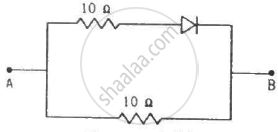
(Assume that the resistance of each diode is zero in forward bias and is infinity in reverse bias.)
When the base current in a transistor is changed from 30µA to 80µA, the collector current is changed from 1.0 mA to 3.5 mA. Find the current gain β.
An AC source is connected to a diode and a resistor in series. Is the current thorough the resistor AC or DC?
If in a p-n junction diode, a square input signal of 10 V is applied as shown Then the output signal across RL will be ______

Zener breakdown occurs in a p-n junction having p and n both:
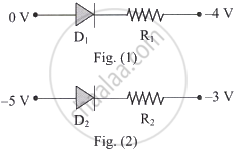
Diode and resistance are connected as shown in figure. Out of the following statements which one is TRUE?
What is the depletion region?
What is drift?
What is static resistance?
Why does microscopic roughness prevent a proper crystal lattice from forming between separate p-type and n-type slabs?
Which semiconductor devices use the p-n junction principle?
Which formula gives the dynamic resistance of a diode?
