Advertisements
Advertisements
प्रश्न
What are the readings of the ammeters A1 and A2 shown in figure. Neglect the resistance of the meters.
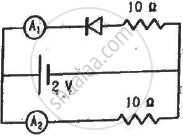
(Assume that the resistance of each diode is zero in forward bias and is infinity in reverse bias.)
Advertisements
उत्तर
From the circuit diagram, we can see that one diode (the upper one) is reverse biassed.
We know that when a diode is forward biassed, it has zero resistance ideally. So, it can be replaced by a short circuit. When a diode is reverse biassed, it has infinite resistance ideally. So, it can be replaced by an open circuit.
Thus,
In the given circuit, one diode is reverse biassed. So, it can be replaced by an open circuit. Hence, the current in this branch will be zero.
So, the current through A1 is zero.
For A2,
Current = \[\frac{2}{10}\] = 0.2 A
APPEARS IN
संबंधित प्रश्न
Draw a circuit diagram to study the input and output characteristics of an n-p-n transistor in its common emitter configuration. Draw the typical input and output characteristics.
How is a zener diode fabricated so as to make it a special purpose diode? Draw I-V characteristics of zener diode and explain the significance of breakdown voltage.
Explain briefly, with the help of a circuit diagram, how a p-n junction diode works as a half wave rectifier.
When a p-type impurity is doped in a semiconductor, a large number of holes are created, This does not make the semiconductor charged. But when holes diffuse from the p-side to the n-side in a p-n junction, the n-side gets positively charged. Explain.
A semiconducting device is connected in a series circuit with a battery and a resistance. A current is found to pass through the circuit. If the polarity of the battery is reversed, the current drops to almost zero. the device may be
(a) an intrinsic semiconductor
(b) a p-type semiconductor
(c) an n-type semiconductor
(d) a p-n junction
The drift current in a p-n junction is 20.0 µA. Estimate the number of electrons crossing a cross section per second in the depletion region.
Consider a p-n junction diode having the characteristic \[i - i_0 ( e^{eV/kT} - 1) \text{ where } i_0 = 20\mu A\] . The diode is operated at T = 300 K . (a) Find the current through the diode when a voltage of 300 mV is applied across it in forward bias. (b) At what voltage does the current double?
When the base current in a transistor is changed from 30µA to 80µA, the collector current is changed from 1.0 mA to 3.5 mA. Find the current gain β.
A load resistor of 2kΩ is connected in the collector branch of an amplifier circuit using a transistor in common-emitter mode. The current gain β = 50. The input resistance of the transistor is 0.50 kΩ. If the input current is changed by 50µA. (a) by what amount does the output voltage change, (b) by what amount does the input voltage change and (c) what is the power gain?
In a semiconductor diode, the barrier potential offers opposition to only ______.
Zener breakdown occurs in a p-n junction having p and n both:
The formation of the depletion region in a p-n junction diode is due to ______.
During the formation of a p-n junction ______.
For an ideal diode, in forward and reverse biased condition the resistance is respectively ______.
Which process moves charge carriers from a higher concentration to a lower concentration?
What is drift?
What is static resistance?
How is a true p-n junction created instead of physically joining separate semiconductor pieces?
What is the approximate knee voltage for silicon?
Which formula gives the static resistance of a diode?
