Advertisements
Advertisements
Question
What are the readings of the ammeters A1 and A2 shown in figure. Neglect the resistance of the meters.
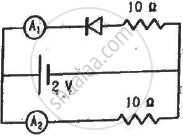
(Assume that the resistance of each diode is zero in forward bias and is infinity in reverse bias.)
Advertisements
Solution
From the circuit diagram, we can see that one diode (the upper one) is reverse biassed.
We know that when a diode is forward biassed, it has zero resistance ideally. So, it can be replaced by a short circuit. When a diode is reverse biassed, it has infinite resistance ideally. So, it can be replaced by an open circuit.
Thus,
In the given circuit, one diode is reverse biassed. So, it can be replaced by an open circuit. Hence, the current in this branch will be zero.
So, the current through A1 is zero.
For A2,
Current = \[\frac{2}{10}\] = 0.2 A
APPEARS IN
RELATED QUESTIONS
A zener diode is fabricated by heavily doping both p- and n- sides of the junction. Explain, why?
Explain briefly with the help of necessary diagrams, the reverse biasing of a p-n junction diode. Also draw characteristic curves.
The drift current in a reverse-biased p-n junction is increased in magnitude if the temperature of the junction is increased. Explain this on the basis of creation of hole-electron pairs.
If the two ends of a p-n junction are joined by a wire,
The drift current in a p-n junction is
Diffusion current in a p-n junction is greater than the drift current in magnitude
Two identical p-n junction may be connected in series with a battery in three ways. The potential difference across the two p-n junctions are equal in

A semiconducting device is connected in a series circuit with a battery and a resistance. A current is found to pass through the circuit. If the polarity of the battery is reversed, the current drops to almost zero. the device may be
(a) an intrinsic semiconductor
(b) a p-type semiconductor
(c) an n-type semiconductor
(d) a p-n junction
When a p-n junction is reverse-biased, the current becomes almost constant at 25 µA. When it is forward-biased at 200 mV, a current of 75 µA is obtained. Find the magnitude of diffusion current when the diode is
(a) unbiased,
(b) reverse-biased at 200 mV and
(c) forward-biased at 200 mV.
The current−voltage characteristic of an ideal p-n junction diode is given by \[i = i_0 ( e^{eV/KT} - 1)\] where, the drift current i0 equals 10 µA. Take the temperature T to be 300 K. (a) Find the voltage V0 for which \[e^{eV/kT} = 100 .\]One can neglect the term 1 for voltages greater than this value. (b) Find an expression for the dynamic resistance of the diode as a function of V for V > V0. (c) Find the voltage for which the dynamic resistance is 0.2 Ω.
(Use Planck constant h = 4.14 × 10⁻¹⁵ eV-s, Boltzmann constant k = 8·62 × 10-5 eV/K.)
Draw the current-voltage characteristics for the device show in figure between the terminals A and B.
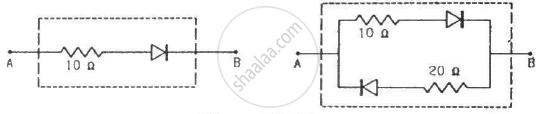
(Assume that the resistance of each diode is zero in forward bias and is infinity in reverse bias.)
Find the equivalent resistance of the network shown in figure between the points A and B.
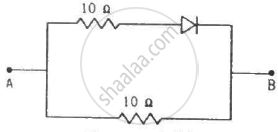
(Assume that the resistance of each diode is zero in forward bias and is infinity in reverse bias.)
In a semiconductor diode, the barrier potential offers opposition to only ______.
What is a p-n junction diode?
What is drift?
When p-type and n-type regions are formed in a single crystal, which carriers initially diffuse from each side?
Which charge carriers remain near the junction after the region loses mobile charge carriers?
In which direction is the electric field established by the fixed ions?
How is a true p-n junction created instead of physically joining separate semiconductor pieces?
