Advertisements
Advertisements
Question
Find the currents through the resistance in the circuits shown in figure.
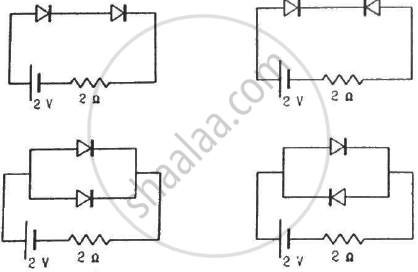
(Assume that the resistance of each diode is zero in forward bias and is infinity in reverse bias.)
Advertisements
Solution
We know that under forward bias, an ideal diode acts as a short circuit; and under reverse bias, an ideal diode acts as an open circuit.
(a) Since both the diodes are forward biassed, they can be replaced by short circuits.
Net resistance = 2 Ω
\[i = \frac{2 V}{2 \Omega} = 1 A\]
(b) One diode is forward biassed and the other is reverse biassed; thus, the resistance of one becomes ∞. The circuit becomes open at the position of the second diode, so no current flows through this arm.
\[\therefore i = \frac{2}{2 + \infty} = 0 A\]
(c) Both of them are forward biassed. Thus, the resistance is zero.
We can replace both the resistors by short circuits.
Net resistance = 2 Ω
\[\therefore i = \frac{2}{2} = 1 A\]
(d) One of them is forward biassed and the other is reverse biassed.
Thus, the current passes through the forward-biassed diode and the other acts as open circuit.
\[\therefore i = \frac{2}{2} = 1 A\]
APPEARS IN
RELATED QUESTIONS
In a p-n junction diode, the current I can be expressed as
I = `"I"_0 exp ("eV"/(2"k"_"BT") - 1)`
where I0 is called the reverse saturation current, V is the voltage across the diode and is positive for forward bias and negative for reverse bias, and I is the current through the diode, kBis the Boltzmann constant (8.6×10⁻⁵ eV/K) and T is the absolute temperature. If for a given diode I0 = 5 × 10⁻¹² A and T = 300 K, then
(a) What will be the forward current at a forward voltage of 0.6 V?
(b) What will be the increase in the current if the voltage across the diode is increased to 0.7 V?
(c) What is the dynamic resistance?
(d) What will be the current if reverse bias voltage changes from 1 V to 2 V?
Explain briefly with the help of necessary diagrams, the reverse biasing of a p-n junction diode. Also draw characteristic curves.
Draw a circuit diagram to study the input and output characteristics of an n-p-n transistor in its common emitter configuration. Draw the typical input and output characteristics.
The drift current in a reverse-biased p-n junction is increased in magnitude if the temperature of the junction is increased. Explain this on the basis of creation of hole-electron pairs.
A hole diffuses from the p-side to the n-side in a p-n junction. This means that
A semiconducting device is connected in a series circuit with a battery and a resistance. A current is found to pass through the circuit. If the polarity of the battery is reversed, the current drops to almost zero. the device may be
(a) an intrinsic semiconductor
(b) a p-type semiconductor
(c) an n-type semiconductor
(d) a p-n junction
When a p-n junction is reverse-biased, the current becomes almost constant at 25 µA. When it is forward-biased at 200 mV, a current of 75 µA is obtained. Find the magnitude of diffusion current when the diode is
(a) unbiased,
(b) reverse-biased at 200 mV and
(c) forward-biased at 200 mV.
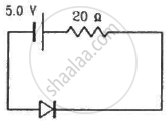
Calculate the current through the circuit and the potential difference across the diode shown in figure. The drift current for the diode is 20 µA.
An AC source is connected to a diode and a resistor in series. Is the current thorough the resistor AC or DC?
The depletion layer in the p-n junction diode is caused by ______.
Zener breakdown occurs in a p-n junction having p and n both:
What is a p-n junction diode?
Which process moves charge carriers from a higher concentration to a lower concentration?
What is static resistance?
Which charge carriers remain near the junction after the region loses mobile charge carriers?
In which circuits are diodes used for signal detection?
What is the approximate knee voltage for germanium?
