Advertisements
Advertisements
प्रश्न
Find the currents through the resistance in the circuits shown in figure.
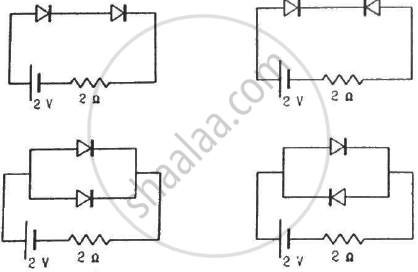
(Assume that the resistance of each diode is zero in forward bias and is infinity in reverse bias.)
Advertisements
उत्तर
We know that under forward bias, an ideal diode acts as a short circuit; and under reverse bias, an ideal diode acts as an open circuit.
(a) Since both the diodes are forward biassed, they can be replaced by short circuits.
Net resistance = 2 Ω
\[i = \frac{2 V}{2 \Omega} = 1 A\]
(b) One diode is forward biassed and the other is reverse biassed; thus, the resistance of one becomes ∞. The circuit becomes open at the position of the second diode, so no current flows through this arm.
\[\therefore i = \frac{2}{2 + \infty} = 0 A\]
(c) Both of them are forward biassed. Thus, the resistance is zero.
We can replace both the resistors by short circuits.
Net resistance = 2 Ω
\[\therefore i = \frac{2}{2} = 1 A\]
(d) One of them is forward biassed and the other is reverse biassed.
Thus, the current passes through the forward-biassed diode and the other acts as open circuit.
\[\therefore i = \frac{2}{2} = 1 A\]
APPEARS IN
संबंधित प्रश्न
In a p-n junction diode, the current I can be expressed as
I = `"I"_0 exp ("eV"/(2"k"_"BT") - 1)`
where I0 is called the reverse saturation current, V is the voltage across the diode and is positive for forward bias and negative for reverse bias, and I is the current through the diode, kBis the Boltzmann constant (8.6×10⁻⁵ eV/K) and T is the absolute temperature. If for a given diode I0 = 5 × 10⁻¹² A and T = 300 K, then
(a) What will be the forward current at a forward voltage of 0.6 V?
(b) What will be the increase in the current if the voltage across the diode is increased to 0.7 V?
(c) What is the dynamic resistance?
(d) What will be the current if reverse bias voltage changes from 1 V to 2 V?
Write the two processes that take place in the formation of a p-n junction.
A zener diode is fabricated by heavily doping both p- and n- sides of the junction. Explain, why?
Explain briefly with the help of necessary diagrams, the forward biasing of a p-n junction diode. Also draw characteristic curves.
Explain briefly with the help of necessary diagrams, the reverse biasing of a p-n junction diode. Also draw characteristic curves.
A student wants to use two p-n junction diodes to convert alternating current into direct current. Draw the labelled circuit diagram she would use and explain how it works.
Explain, with the help of a circuit diagram, the working of a photo-diode. Write briefly how it is used to detect the optical signals.
How is a zener diode fabricated so as to make it a special purpose diode? Draw I-V characteristics of zener diode and explain the significance of breakdown voltage.
Explain briefly, with the help of a circuit diagram, how a p-n junction diode works as a half wave rectifier.
Diffusion current in a p-n junction is greater than the drift current in magnitude
In a p-n junction, a potential barrier of 250 meV exists across the junction. A hole with a kinetic energy of 300 meV approaches the junction. Find the kinetic energy of the hole when it crosses the junction if the hole approached the junction (a) from the p-side and (b) from the n-side.
The drift current in a p-n junction is 20.0 µA. Estimate the number of electrons crossing a cross section per second in the depletion region.
Consider a p-n junction diode having the characteristic \[i - i_0 ( e^{eV/kT} - 1) \text{ where } i_0 = 20\mu A\] . The diode is operated at T = 300 K . (a) Find the current through the diode when a voltage of 300 mV is applied across it in forward bias. (b) At what voltage does the current double?
The depletion layer in the p-n junction diode is caused by ______.
Zener breakdown occurs in a p-n junction having p and n both:
During the formation of a p-n junction ______.
What is dynamic resistance?
Why does microscopic roughness prevent a proper crystal lattice from forming between separate p-type and n-type slabs?
What role do diodes perform in electronic switching?
Which formula gives the dynamic resistance of a diode?
