Advertisements
Advertisements
प्रश्न
When a p-type impurity is doped in a semiconductor, a large number of holes are created, This does not make the semiconductor charged. But when holes diffuse from the p-side to the n-side in a p-n junction, the n-side gets positively charged. Explain.
Advertisements
उत्तर
A p-type semiconductor is formed by doping a group 13 element with group 14 element (Si or Ge). As the group 13 element has only 3 electrons in its valence shell and the group 14 element has 4 electrons in its valence shell, when the group 13 element, say, Al, replaces one Si in the silicon crystal, only 3 covalent bonds are formed by it. And the fourth covalent bond is left in need of one electron. So, it creates a hole. Since the atom as a whole is electriclly neutral, the p-type semiconductor is also neutral.
In a p‒n junction, when the diffusion of holes takes place across the junction because of the difference in the concentration of charge carriers from p to n sides, these holes neutralise some of the electrons on the n side. So, the atom attached with that electron becomes one electron deficient and hence positively charged. This makes the n side of the p‒n junction positively charged and the p side of the p‒n junction negatively charged.
APPEARS IN
संबंधित प्रश्न
Draw a circuit diagram to study the input and output characteristics of an n-p-n transistor in its common emitter configuration. Draw the typical input and output characteristics.
How is a zener diode fabricated so as to make it a special purpose diode? Draw I-V characteristics of zener diode and explain the significance of breakdown voltage.
Explain briefly, with the help of a circuit diagram, how a p-n junction diode works as a half wave rectifier.
A hole diffuses from the p-side to the n-side in a p-n junction. This means that
In a p-n junction with open ends,
(a) there is no systematic motion of charge carries
(b) holes and conduction electrons systematically go from the p-side to n-side and from the n-side to p-side respectively
(c) there is no net charge transfer between the two sides
(d) there is a constant electric field near the junction.
The current−voltage characteristic of an ideal p-n junction diode is given by \[i = i_0 ( e^{eV/KT} - 1)\] where, the drift current i0 equals 10 µA. Take the temperature T to be 300 K. (a) Find the voltage V0 for which \[e^{eV/kT} = 100 .\]One can neglect the term 1 for voltages greater than this value. (b) Find an expression for the dynamic resistance of the diode as a function of V for V > V0. (c) Find the voltage for which the dynamic resistance is 0.2 Ω.
(Use Planck constant h = 4.14 × 10⁻¹⁵ eV-s, Boltzmann constant k = 8·62 × 10-5 eV/K.)
Find the current through the battery in each of the circuits shown in figure.
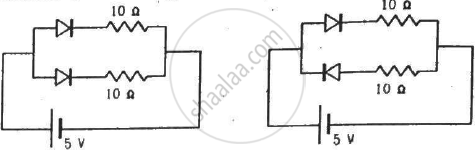
(Assume that the resistance of each diode is zero in forward bias and is infinity in reverse bias.)
Find the current through the resistance R in figure if (a) R = 12Ω (b) R = 48Ω.
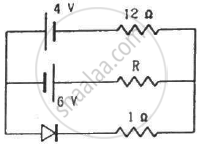
(Assume that the resistance of each diode is zero in forward bias and is infinity in reverse bias.)
Find the equivalent resistance of the network shown in figure between the points A and B.
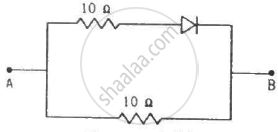
(Assume that the resistance of each diode is zero in forward bias and is infinity in reverse bias.)
An AC source is connected to a diode and a resistor in series. Is the current thorough the resistor AC or DC?
Answer in detail.
Discuss the effect of external voltage on the width of depletion region of a p-n junction.
In p-n junction diode ______.
What is the depletion region?
What is barrier potential?
What is drift?
What is static resistance?
Which semiconductor devices use the p-n junction principle?
What is the net current in zero bias when diffusion and drift currents balance?
Which formula gives the dynamic resistance of a diode?
