Advertisements
Advertisements
प्रश्न
Diffusion current in a p-n junction is greater than the drift current in magnitude
पर्याय
if the junction is forward-biased
if the junction is reverse-biased
if the junction is unbiased
in no case.
Advertisements
उत्तर
if the junction is forward-biassed
In the forward biassing of a p−n junction, the positive terminal of the battery is connected to the p side of the p−n junction and the negative terminal of the battery is connected to the n side of the p−n junction. As a result, electrons in the n side of the p−njunction are repelled by the negative terminal of the battery and move to the p side, where the positive terminal of the battery attracts the electrons. Similarly, holes from the p side of the p−n junction are repelled by the positive terminal of the battery and move to the n side, where the negative terminal of the battery attracts the holes. Thus, they give diffusion current across the p−n junction.
In case of reverse biassing, no conduction takes place across the junction because of the diffusion of majority carriers. Hence, there is no diffusion current.
If the junction is unbiased, then diffusion current is initially maximum. But at equilibrium, diffusion current becomes equal to drift current.
APPEARS IN
संबंधित प्रश्न
Explain briefly with the help of necessary diagrams, the forward biasing of a p-n junction diode. Also draw characteristic curves.
Mention the important considerations required while fabricating a p-n junction diode to be used as a Light Emitting Diode (LED). What should be the order of band gap of an LED if it is required to emit light in the visible range?
Draw a circuit diagram to study the input and output characteristics of an n-p-n transistor in its common emitter configuration. Draw the typical input and output characteristics.
Explain, with the help of a circuit diagram, the working of n-p-n transistor as a common emitter amplifier.
In a p-n junction with open ends,
(a) there is no systematic motion of charge carries
(b) holes and conduction electrons systematically go from the p-side to n-side and from the n-side to p-side respectively
(c) there is no net charge transfer between the two sides
(d) there is a constant electric field near the junction.
The current−voltage characteristic of an ideal p-n junction diode is given by \[i = i_0 ( e^{eV/KT} - 1)\] where, the drift current i0 equals 10 µA. Take the temperature T to be 300 K. (a) Find the voltage V0 for which \[e^{eV/kT} = 100 .\]One can neglect the term 1 for voltages greater than this value. (b) Find an expression for the dynamic resistance of the diode as a function of V for V > V0. (c) Find the voltage for which the dynamic resistance is 0.2 Ω.
(Use Planck constant h = 4.14 × 10⁻¹⁵ eV-s, Boltzmann constant k = 8·62 × 10-5 eV/K.)
What are the readings of the ammeters A1 and A2 shown in figure. Neglect the resistance of the meters.
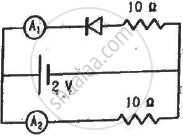
(Assume that the resistance of each diode is zero in forward bias and is infinity in reverse bias.)
Find the current through the resistance R in figure if (a) R = 12Ω (b) R = 48Ω.
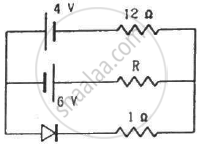
(Assume that the resistance of each diode is zero in forward bias and is infinity in reverse bias.)
Find the equivalent resistance of the network shown in figure between the points A and B.
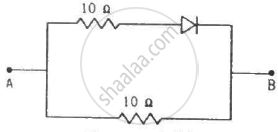
(Assume that the resistance of each diode is zero in forward bias and is infinity in reverse bias.)
Answer in detail.
Discuss the effect of external voltage on the width of depletion region of a p-n junction.
In a semiconductor diode, the barrier potential offers opposition to only ______.
For an ideal diode, in forward and reverse biased condition the resistance is respectively ______.
Diode and resistance are connected as shown in figure. Out of the following statements which one is TRUE?
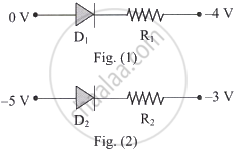
What is barrier potential?
What is a p-n junction diode?
How does the interface between physically joined p-type and n-type slabs act on charge carriers?
What is the use of diodes in power supplies and chargers?
What is the net current in zero bias when diffusion and drift currents balance?
Which formula gives the static resistance of a diode?
