Advertisements
Advertisements
प्रश्न
How is a zener diode fabricated so as to make it a special purpose diode? Draw I-V characteristics of zener diode and explain the significance of breakdown voltage.
Explain briefly, with the help of a circuit diagram, how a p-n junction diode works as a half wave rectifier.
Advertisements
उत्तर
Zener is fabricated such that both the p-type and the n-type are highly doped. This makes the depletion region thin. When an electric field is applied, a high electric field appears across the thin depletion region. When the electric field becomes very high, it knocks off electrons from the host atoms to create a large number of electrons. This results in a large value of current inside the circuit.
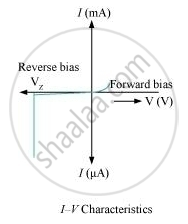
Zener has a sharp breakdown voltage and this property of zener is used for voltage regulation.
An ac current has a positive half cycle and a negative half cycle. A pn junction allows current to pass only in one direction and that is when it is forward biased.
When a positive half-cycle occurs, the p-side has a lower potential. Therefore, the diode is now forward biased and therefore conducts and this positive cycle is available for the load.
When a negative half cycle occurs, the n-side has a higher potential than the p-side. Hence, the diode is now reverse biased and thus, does not conduct. As a result, this positive half cycle also does not conduct. Therefore, it does not appear at the load and is cut-off.
We obtain a waveform, which has only positive half cycles and therefore it is called half-wave rectifier.
APPEARS IN
संबंधित प्रश्न
Diffusion current in a p-n junction is greater than the drift current in magnitude
In a p.n junction, the depletion region is 400 nm wide and an electric field of 5 × 10⁵ V m−1 exists in it. (a) Find the height of the potential barrier. (b) What should be the minimum kinetic energy of a conduction electron which can diffuse from the n-side to the p-side?
Find the current through the battery in each of the circuits shown in figure.
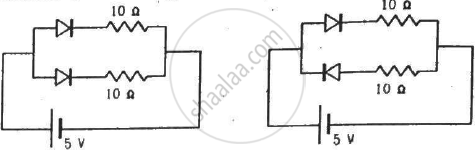
(Assume that the resistance of each diode is zero in forward bias and is infinity in reverse bias.)
Find the equivalent resistance of the network shown in figure between the points A and B.
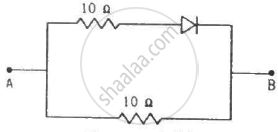
(Assume that the resistance of each diode is zero in forward bias and is infinity in reverse bias.)
The formation of the depletion region in a p-n junction diode is due to ______.
What is drift?
What is dynamic resistance?
In which direction is the electric field established by the fixed ions?
How does the interface between physically joined p-type and n-type slabs act on charge carriers?
What is the net current in zero bias when diffusion and drift currents balance?
