Advertisements
Advertisements
प्रश्न
The current−voltage characteristic of an ideal p-n junction diode is given by \[i = i_0 ( e^{eV/KT} - 1)\] where, the drift current i0 equals 10 µA. Take the temperature T to be 300 K. (a) Find the voltage V0 for which \[e^{eV/kT} = 100 .\]One can neglect the term 1 for voltages greater than this value. (b) Find an expression for the dynamic resistance of the diode as a function of V for V > V0. (c) Find the voltage for which the dynamic resistance is 0.2 Ω.
(Use Planck constant h = 4.14 × 10⁻¹⁵ eV-s, Boltzmann constant k = 8·62 × 10-5 eV/K.)
Advertisements
उत्तर
(a) The current‒voltage relationship of a diode is given by
\[i = i_0 ( e^{eV/kT - 1} )\]
For a large value of voltage, 1 can be neglected.
\[i \approx i_0 e^{eV/kT}\]
Again, we need to find the voltage at which
\[e^{eV/kT} = 100\]
\[\Rightarrow \frac{eV}{kT} = \text{ln }100\]
\[ \Rightarrow V = \frac{\text{ ln }100 \times \text{ kT }}{e}\]
\[ \Rightarrow V = \frac{2 . 303 \times \log 100 \times 8 . 62 \times {10}^{- 5} \times 300}{e}\]
\[ \Rightarrow V=0.12\] V
(b) Given:-
\[i = i_0 ( e^{eV/kT - 1} ) ...........(1)\]
We know that the dynamic resistance of a diode is the rate of change of voltage w.r.t. current.
i.e.
\[R = \frac{d V}{\text{d i}}\]
As the exponential factor dominates the factor of 1, we can neglect this factor.
Now, on differentiating eq. (1) w.r.t. V, we get
\[\frac{\text{di}}{\text{dV}} = i_0 \frac{e}{kT} e^{eV/kT} \]
\[ \Rightarrow \frac{1}{R} = \frac{e i_0}{kT} e^{eV/kT} \]
\[ \Rightarrow R = \frac{kT}{e i_0} e^{- eV/kT} ............(2)\]
(c) Given:-
R = 2 Ω
On substituting this value in eq. (2), we get
\[2 = \frac{8 . 62 \times {10}^{- 5} \times 300}{e \times 10 \times {10}^{- 6}} e^{- eV/8 . 62 \times {10}^{- 5} \times 300} \]
\[ \Rightarrow V = 0 . 25 \] V
APPEARS IN
संबंधित प्रश्न
In an unbiased p-n junction, holes diffuse from the p-region to n-region because ______.
A student wants to use two p-n junction diodes to convert alternating current into direct current. Draw the labelled circuit diagram she would use and explain how it works.
When a p-type impurity is doped in a semiconductor, a large number of holes are created, This does not make the semiconductor charged. But when holes diffuse from the p-side to the n-side in a p-n junction, the n-side gets positively charged. Explain.
Diffusion current in a p-n junction is greater than the drift current in magnitude
The potential barrier existing across an unbiased p-n junction is 0.2 volt. What minimum kinetic energy a hole should have to diffuse from the p-side to the n-side if (a) the junction is unbiased, (b) the junction is forward-biased at 0.1 volt and (c) the junction is reverse-biased at 0.1 volt?
What are the readings of the ammeters A1 and A2 shown in figure. Neglect the resistance of the meters.
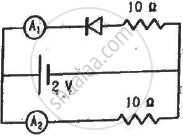
(Assume that the resistance of each diode is zero in forward bias and is infinity in reverse bias.)
Find the equivalent resistance of the network shown in figure between the points A and B.
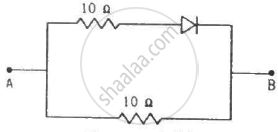
(Assume that the resistance of each diode is zero in forward bias and is infinity in reverse bias.)
When the base current in a transistor is changed from 30µA to 80µA, the collector current is changed from 1.0 mA to 3.5 mA. Find the current gain β.
A load resistor of 2kΩ is connected in the collector branch of an amplifier circuit using a transistor in common-emitter mode. The current gain β = 50. The input resistance of the transistor is 0.50 kΩ. If the input current is changed by 50µA. (a) by what amount does the output voltage change, (b) by what amount does the input voltage change and (c) what is the power gain?
An AC source is connected to a diode and a resistor in series. Is the current thorough the resistor AC or DC?
A diode, a resistor and a 50 Hz AC source are connected in series. The number of current pulses per second through the resistor is __________ .
During the formation of a p-n junction ______.
For an ideal diode, in forward and reverse biased condition the resistance is respectively ______.
Diode and resistance are connected as shown in figure. Out of the following statements which one is TRUE?
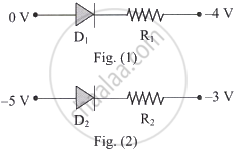
Which process moves charge carriers from a higher concentration to a lower concentration?
How does the interface between physically joined p-type and n-type slabs act on charge carriers?
What is the use of diodes in power supplies and chargers?
In which circuits are diodes used for signal detection?
