Advertisements
Advertisements
प्रश्न
The formation of the depletion region in a p-n junction diode is due to ______.
पर्याय
movement of dopant atoms
diffusion of both electrons and holes
drift of electrons only
the drift of holes only
Advertisements
उत्तर
The formation of the depletion region in a p-n junction diode is due to the diffusion of both electrons and holes.
Explanation:
Charge diffusion is what creates the depletion area. holes diffuse across the junction from the p-side to the n-side due to the concentration gradient, whereas electrons diffuse from the n-side to the p-side. Near the junction, the holes and the electrons that are diffusely moving in the same direction unite.
APPEARS IN
संबंधित प्रश्न
In an unbiased p-n junction, holes diffuse from the p-region to n-region because ______.
The potential barrier existing across an unbiased p-n junction is 0.2 volt. What minimum kinetic energy a hole should have to diffuse from the p-side to the n-side if (a) the junction is unbiased, (b) the junction is forward-biased at 0.1 volt and (c) the junction is reverse-biased at 0.1 volt?
In a p-n junction, a potential barrier of 250 meV exists across the junction. A hole with a kinetic energy of 300 meV approaches the junction. Find the kinetic energy of the hole when it crosses the junction if the hole approached the junction (a) from the p-side and (b) from the n-side.
Find the currents through the resistance in the circuits shown in figure.
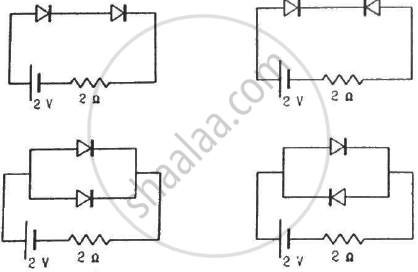
(Assume that the resistance of each diode is zero in forward bias and is infinity in reverse bias.)
Choose the correct option.
Current through a reverse-biased p-n junction increases abruptly at:
p-n junction diode is formed
What is the depletion region?
What is drift?
When p-type and n-type regions are formed in a single crystal, which carriers initially diffuse from each side?
What is the use of diodes in power supplies and chargers?
