Advertisements
Advertisements
प्रश्न
A hole diffuses from the p-side to the n-side in a p-n junction. This means that
पर्याय
a bond is broken on the n-side and the electron freed from the bond jumps to the conduction band
a conduction electron on the p-side jumps to a broken bond to complete it
a bond is broken on the n-side and the electron freed from the bond jumps to a broken bond on the p-side to complete it
a bond is broken on the p-side and the electron freed from the bond jumps to a broken bond on the n-side to complete it.
Advertisements
उत्तर
a bond is broken on the n-side and the electron freed from the bond jumps to a broken bond on the p-side to complete it
A hole diffuses from the p side to the n side in a p−n junction; that is, an electron moves from the n side to the p side. This implies that a bond is broken on the n side. As the electron travels towards the p side, which is rich in holes, it combines with a hole. A hole is created because of the deficiency of one electron. So, when an electron combines with a hole, it completes that bond.
APPEARS IN
संबंधित प्रश्न
Explain briefly with the help of necessary diagrams, the reverse biasing of a p-n junction diode. Also draw characteristic curves.
Mention the important considerations required while fabricating a p-n junction diode to be used as a Light Emitting Diode (LED). What should be the order of band gap of an LED if it is required to emit light in the visible range?
Draw a circuit diagram to study the input and output characteristics of an n-p-n transistor in its common emitter configuration. Draw the typical input and output characteristics.
If the two ends of a p-n junction are joined by a wire,
The drift current in a p-n junction is
Two identical p-n junction may be connected in series with a battery in three ways. The potential difference across the two p-n junctions are equal in

In a p-n junction,
(a) new holes and conduction electrons are produced continuously throughout the material
(b) new holes and conduction electrons are produced continuously throughout the material except in the depletion region
(c) holes and conduction electrons recombine continuously throughout the material
(d) holes and conduction electrons recombine continuously throughout the material except in the depletion region.
Consider a p-n junction diode having the characteristic \[i - i_0 ( e^{eV/kT} - 1) \text{ where } i_0 = 20\mu A\] . The diode is operated at T = 300 K . (a) Find the current through the diode when a voltage of 300 mV is applied across it in forward bias. (b) At what voltage does the current double?
Find the currents through the resistance in the circuits shown in figure.
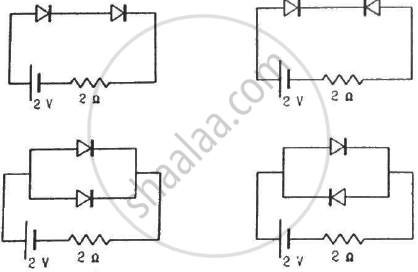
(Assume that the resistance of each diode is zero in forward bias and is infinity in reverse bias.)
Find the current through the battery in each of the circuits shown in figure.
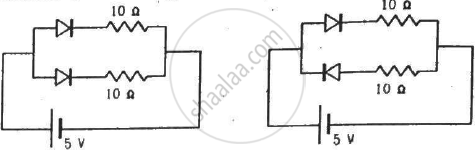
(Assume that the resistance of each diode is zero in forward bias and is infinity in reverse bias.)
Find the equivalent resistance of the network shown in figure between the points A and B.
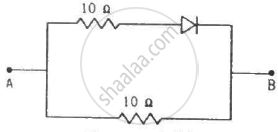
(Assume that the resistance of each diode is zero in forward bias and is infinity in reverse bias.)
A load resistor of 2kΩ is connected in the collector branch of an amplifier circuit using a transistor in common-emitter mode. The current gain β = 50. The input resistance of the transistor is 0.50 kΩ. If the input current is changed by 50µA. (a) by what amount does the output voltage change, (b) by what amount does the input voltage change and (c) what is the power gain?
If in a p-n junction diode, a square input signal of 10 V is applied as shown Then the output signal across RL will be ______

The depletion layer in the p-n junction diode is caused by ______.
During the formation of a p-n junction ______.
In p-n junction diode ______.
When p-type and n-type regions are formed in a single crystal, which carriers initially diffuse from each side?
In which direction is the electric field established by the fixed ions?
What is the approximate knee voltage for silicon?
