Advertisements
Advertisements
प्रश्न
If the two ends of a p-n junction are joined by a wire,
पर्याय
there will not be a steady current in the circuit
there will be a steady current from the n-side to the p-side
there will a steady current from the p-side to the n-side
there may or may not be a current depending upon the resistance of the connecting wire
Advertisements
उत्तर
there will not be a steady current in the circuit
In a p‒n junction, current flows only if it is connected to the battery. If two ends of a p‒njunction are joined by a wire, then there will be diffusion and drift currents in the circuit and they will cancel each other. Hence, no current will flow in the circuit.
APPEARS IN
संबंधित प्रश्न
Explain briefly with the help of necessary diagrams, the forward biasing of a p-n junction diode. Also draw characteristic curves.
Explain briefly with the help of necessary diagrams, the reverse biasing of a p-n junction diode. Also draw characteristic curves.
How is a zener diode fabricated so as to make it a special purpose diode? Draw I-V characteristics of zener diode and explain the significance of breakdown voltage.
Explain briefly, with the help of a circuit diagram, how a p-n junction diode works as a half wave rectifier.
The drift current in a p-n junction is
Two identical p-n junction may be connected in series with a battery in three ways. The potential difference across the two p-n junctions are equal in

A semiconducting device is connected in a series circuit with a battery and a resistance. A current is found to pass through the circuit. If the polarity of the battery is reversed, the current drops to almost zero. the device may be
(a) an intrinsic semiconductor
(b) a p-type semiconductor
(c) an n-type semiconductor
(d) a p-n junction
The potential barrier existing across an unbiased p-n junction is 0.2 volt. What minimum kinetic energy a hole should have to diffuse from the p-side to the n-side if (a) the junction is unbiased, (b) the junction is forward-biased at 0.1 volt and (c) the junction is reverse-biased at 0.1 volt?
When a p-n junction is reverse-biased, the current becomes almost constant at 25 µA. When it is forward-biased at 200 mV, a current of 75 µA is obtained. Find the magnitude of diffusion current when the diode is
(a) unbiased,
(b) reverse-biased at 200 mV and
(c) forward-biased at 200 mV.
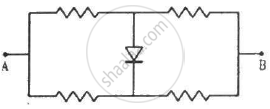
Each of the resistance shown in figure has a value of 20 Ω. Find the equivalent resistance between A and B. Does it depend on whether the point A or B is at higher potential?
Find the current through the resistance R in figure if (a) R = 12Ω (b) R = 48Ω.
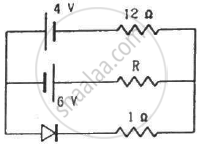
(Assume that the resistance of each diode is zero in forward bias and is infinity in reverse bias.)
Find the equivalent resistance of the network shown in figure between the points A and B.
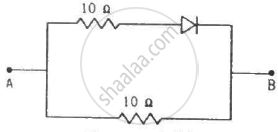
(Assume that the resistance of each diode is zero in forward bias and is infinity in reverse bias.)
The formation of the depletion region in a p-n junction diode is due to ______.
For an ideal diode, in forward and reverse biased condition the resistance is respectively ______.
What is drift?
What is static resistance?
When p-type and n-type regions are formed in a single crystal, which carriers initially diffuse from each side?
Why does microscopic roughness prevent a proper crystal lattice from forming between separate p-type and n-type slabs?
How does the interface between physically joined p-type and n-type slabs act on charge carriers?
What is the use of diodes in power supplies and chargers?
What is the approximate knee voltage for silicon?
