Advertisements
Advertisements
प्रश्न
Explain, with the help of a circuit diagram, the working of a photo-diode. Write briefly how it is used to detect the optical signals.
Advertisements
उत्तर
Working of photo diode:
A junction diode made from light sensitive semi-conductor is called a photodiode.

A photodiode is an electrical device used to detect and convert light into an energy signal through the use of a photo detector. It is a pn-junction whose function is controlled by the light allowed to fall on it. Suppose, the wavelength is such that the energy of a photon, hc/λ, is sufficient to break a valance bond. When such light falls on the junction, new hole-electron pairs are created. The number of charge carriers increases and hence the conductivity of the junction increases. If the junction is connected in some circuit, the current in the circuit is controlled by the intensity of the incident light.
APPEARS IN
संबंधित प्रश्न
Explain briefly with the help of necessary diagrams, the forward biasing of a p-n junction diode. Also draw characteristic curves.
Mention the important considerations required while fabricating a p-n junction diode to be used as a Light Emitting Diode (LED). What should be the order of band gap of an LED if it is required to emit light in the visible range?
When a p-type impurity is doped in a semiconductor, a large number of holes are created, This does not make the semiconductor charged. But when holes diffuse from the p-side to the n-side in a p-n junction, the n-side gets positively charged. Explain.
The drift current in a p-n junction is
Diffusion current in a p-n junction is greater than the drift current in magnitude
Find the currents through the resistance in the circuits shown in figure.
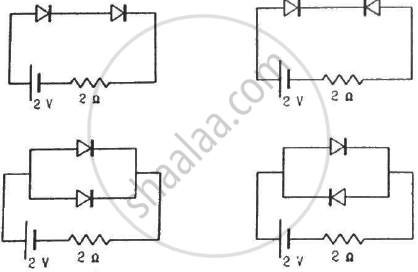
(Assume that the resistance of each diode is zero in forward bias and is infinity in reverse bias.)
In a semiconductor diode, the barrier potential offers opposition to only ______.
In p-n junction diode ______.
What is drift?
What is the approximate knee voltage for silicon?
