Advertisements
Advertisements
प्रश्न
The potential barrier existing across an unbiased p-n junction is 0.2 volt. What minimum kinetic energy a hole should have to diffuse from the p-side to the n-side if (a) the junction is unbiased, (b) the junction is forward-biased at 0.1 volt and (c) the junction is reverse-biased at 0.1 volt?
Advertisements
उत्तर
Potential barrier = 0.2 V
(a) The minimum kinetic energy of the hole should be equal to the band gap of the material.
Band gap = eV
KE = Potential difference × e = 0.2 eV
(b) In forward biassing,
Kinetic energy = Effective potential of the barrier
∴ Kinetic energy = Potential under unbiased condition - Applied voltage
⇒ KE + Ve = 0.2 eV
Here, V is the applied voltage.
⇒ KE = 0.2 − 0.1 = 0.1 eV
(c) In reverse biassing,
Kinetic energy = Effective potential of the barrier
∴ Kinetic energy = Potential under unbiased condition + Applied voltage
⇒ KE − Ve = 0.2 eV
Here, V is the applied voltage.
⇒ KE = 0.2 + 0.1 = 0.3 eV
APPEARS IN
संबंधित प्रश्न
In an unbiased p-n junction, holes diffuse from the p-region to n-region because ______.
Draw a circuit diagram to study the input and output characteristics of an n-p-n transistor in its common emitter configuration. Draw the typical input and output characteristics.
The drift current in a p-n junction is
In a p-n junction with open ends,
(a) there is no systematic motion of charge carries
(b) holes and conduction electrons systematically go from the p-side to n-side and from the n-side to p-side respectively
(c) there is no net charge transfer between the two sides
(d) there is a constant electric field near the junction.
In a p-n junction, a potential barrier of 250 meV exists across the junction. A hole with a kinetic energy of 300 meV approaches the junction. Find the kinetic energy of the hole when it crosses the junction if the hole approached the junction (a) from the p-side and (b) from the n-side.
When a p-n junction is reverse-biased, the current becomes almost constant at 25 µA. When it is forward-biased at 200 mV, a current of 75 µA is obtained. Find the magnitude of diffusion current when the diode is
(a) unbiased,
(b) reverse-biased at 200 mV and
(c) forward-biased at 200 mV.
Find the currents through the resistance in the circuits shown in figure.
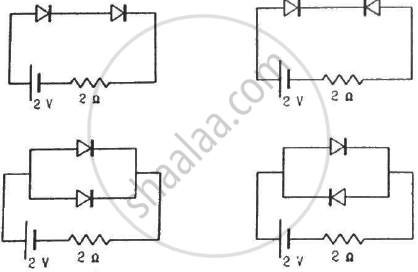
(Assume that the resistance of each diode is zero in forward bias and is infinity in reverse bias.)
What are the readings of the ammeters A1 and A2 shown in figure. Neglect the resistance of the meters.
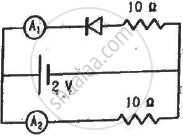
(Assume that the resistance of each diode is zero in forward bias and is infinity in reverse bias.)
Choose the correct option.
Current through a reverse-biased p-n junction increases abruptly at:
Answer in detail.
Discuss the effect of external voltage on the width of depletion region of a p-n junction.
Diode and resistance are connected as shown in figure. Out of the following statements which one is TRUE?
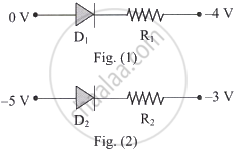
In p-n junction diode ______.
What is drift?
What is dynamic resistance?
When p-type and n-type regions are formed in a single crystal, which carriers initially diffuse from each side?
In which direction is the electric field established by the fixed ions?
Why does microscopic roughness prevent a proper crystal lattice from forming between separate p-type and n-type slabs?
What is the net current in zero bias when diffusion and drift currents balance?
What is the approximate knee voltage for silicon?
