Advertisements
Advertisements
प्रश्न
In a p.n junction, the depletion region is 400 nm wide and an electric field of 5 × 10⁵ V m−1 exists in it. (a) Find the height of the potential barrier. (b) What should be the minimum kinetic energy of a conduction electron which can diffuse from the n-side to the p-side?
Advertisements
उत्तर
Let:
Depletion region width, d = 400 nm = 4 × 10⁻⁷ m
Electric field, E = 5 × 10⁵ Vm−1
(a) Let the potential barrier be V.
The relation between the potential and the electric field is given by V = Ed
\[\Rightarrow\]V = E × d = 5 × d
Energy of any electron accelerated through a potential of V = eV
Also, the minimum energy of the electron should be equal to the band gap of the material.
∴ Potential barrier × e = 0.2 eV (e = Charge of the electron)
APPEARS IN
संबंधित प्रश्न
In an unbiased p-n junction, holes diffuse from the p-region to n-region because ______.
Write the two processes that take place in the formation of a p-n junction.
Explain briefly with the help of necessary diagrams, the reverse biasing of a p-n junction diode. Also draw characteristic curves.
Mention the important considerations required while fabricating a p-n junction diode to be used as a Light Emitting Diode (LED). What should be the order of band gap of an LED if it is required to emit light in the visible range?
Draw a circuit diagram to study the input and output characteristics of an n-p-n transistor in its common emitter configuration. Draw the typical input and output characteristics.
Explain, with the help of a circuit diagram, the working of n-p-n transistor as a common emitter amplifier.
Diffusion current in a p-n junction is greater than the drift current in magnitude
The drift current in a p-n junction is 20.0 µA. Estimate the number of electrons crossing a cross section per second in the depletion region.
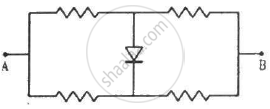
Each of the resistance shown in figure has a value of 20 Ω. Find the equivalent resistance between A and B. Does it depend on whether the point A or B is at higher potential?
When the base current in a transistor is changed from 30µA to 80µA, the collector current is changed from 1.0 mA to 3.5 mA. Find the current gain β.
Answer in detail.
Discuss the effect of external voltage on the width of depletion region of a p-n junction.
For an ideal diode, in forward and reverse biased condition the resistance is respectively ______.
When p-type and n-type regions are formed in a single crystal, which carriers initially diffuse from each side?
Which charge carriers remain near the junction after the region loses mobile charge carriers?
Why does microscopic roughness prevent a proper crystal lattice from forming between separate p-type and n-type slabs?
What is the use of diodes in power supplies and chargers?
What is the approximate knee voltage for silicon?
Which formula gives the static resistance of a diode?
