Advertisements
Advertisements
Question
The current−voltage characteristic of an ideal p-n junction diode is given by \[i = i_0 ( e^{eV/KT} - 1)\] where, the drift current i0 equals 10 µA. Take the temperature T to be 300 K. (a) Find the voltage V0 for which \[e^{eV/kT} = 100 .\]One can neglect the term 1 for voltages greater than this value. (b) Find an expression for the dynamic resistance of the diode as a function of V for V > V0. (c) Find the voltage for which the dynamic resistance is 0.2 Ω.
(Use Planck constant h = 4.14 × 10⁻¹⁵ eV-s, Boltzmann constant k = 8·62 × 10-5 eV/K.)
Advertisements
Solution
(a) The current‒voltage relationship of a diode is given by
\[i = i_0 ( e^{eV/kT - 1} )\]
For a large value of voltage, 1 can be neglected.
\[i \approx i_0 e^{eV/kT}\]
Again, we need to find the voltage at which
\[e^{eV/kT} = 100\]
\[\Rightarrow \frac{eV}{kT} = \text{ln }100\]
\[ \Rightarrow V = \frac{\text{ ln }100 \times \text{ kT }}{e}\]
\[ \Rightarrow V = \frac{2 . 303 \times \log 100 \times 8 . 62 \times {10}^{- 5} \times 300}{e}\]
\[ \Rightarrow V=0.12\] V
(b) Given:-
\[i = i_0 ( e^{eV/kT - 1} ) ...........(1)\]
We know that the dynamic resistance of a diode is the rate of change of voltage w.r.t. current.
i.e.
\[R = \frac{d V}{\text{d i}}\]
As the exponential factor dominates the factor of 1, we can neglect this factor.
Now, on differentiating eq. (1) w.r.t. V, we get
\[\frac{\text{di}}{\text{dV}} = i_0 \frac{e}{kT} e^{eV/kT} \]
\[ \Rightarrow \frac{1}{R} = \frac{e i_0}{kT} e^{eV/kT} \]
\[ \Rightarrow R = \frac{kT}{e i_0} e^{- eV/kT} ............(2)\]
(c) Given:-
R = 2 Ω
On substituting this value in eq. (2), we get
\[2 = \frac{8 . 62 \times {10}^{- 5} \times 300}{e \times 10 \times {10}^{- 6}} e^{- eV/8 . 62 \times {10}^{- 5} \times 300} \]
\[ \Rightarrow V = 0 . 25 \] V
APPEARS IN
RELATED QUESTIONS
In an unbiased p-n junction, holes diffuse from the p-region to n-region because ______.
Explain, with the help of a circuit diagram, the working of a photo-diode. Write briefly how it is used to detect the optical signals.
When a p-type impurity is doped in a semiconductor, a large number of holes are created, This does not make the semiconductor charged. But when holes diffuse from the p-side to the n-side in a p-n junction, the n-side gets positively charged. Explain.
The drift current in a p-n junction is
Diffusion current in a p-n junction is greater than the drift current in magnitude
The potential barrier existing across an unbiased p-n junction is 0.2 volt. What minimum kinetic energy a hole should have to diffuse from the p-side to the n-side if (a) the junction is unbiased, (b) the junction is forward-biased at 0.1 volt and (c) the junction is reverse-biased at 0.1 volt?
The drift current in a p-n junction is 20.0 µA. Estimate the number of electrons crossing a cross section per second in the depletion region.
Find the equivalent resistance of the network shown in figure between the points A and B.
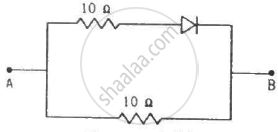
(Assume that the resistance of each diode is zero in forward bias and is infinity in reverse bias.)
If in a p-n junction diode, a square input signal of 10 V is applied as shown Then the output signal across RL will be ______

The depletion layer in the p-n junction diode is caused by ______.
p-n junction diode is formed
During the formation of a p-n junction ______.
For an ideal diode, in forward and reverse biased condition the resistance is respectively ______.
In p-n junction diode ______.
What is the depletion region?
Which process moves charge carriers from a higher concentration to a lower concentration?
In which direction is the electric field established by the fixed ions?
How does the interface between physically joined p-type and n-type slabs act on charge carriers?
What is the approximate knee voltage for germanium?
