Advertisements
Advertisements
Question
When a p-type impurity is doped in a semiconductor, a large number of holes are created, This does not make the semiconductor charged. But when holes diffuse from the p-side to the n-side in a p-n junction, the n-side gets positively charged. Explain.
Advertisements
Solution
A p-type semiconductor is formed by doping a group 13 element with group 14 element (Si or Ge). As the group 13 element has only 3 electrons in its valence shell and the group 14 element has 4 electrons in its valence shell, when the group 13 element, say, Al, replaces one Si in the silicon crystal, only 3 covalent bonds are formed by it. And the fourth covalent bond is left in need of one electron. So, it creates a hole. Since the atom as a whole is electriclly neutral, the p-type semiconductor is also neutral.
In a p‒n junction, when the diffusion of holes takes place across the junction because of the difference in the concentration of charge carriers from p to n sides, these holes neutralise some of the electrons on the n side. So, the atom attached with that electron becomes one electron deficient and hence positively charged. This makes the n side of the p‒n junction positively charged and the p side of the p‒n junction negatively charged.
APPEARS IN
RELATED QUESTIONS
Write the two processes that take place in the formation of a p-n junction.
A zener diode is fabricated by heavily doping both p- and n- sides of the junction. Explain, why?
Draw a circuit diagram to study the input and output characteristics of an n-p-n transistor in its common emitter configuration. Draw the typical input and output characteristics.
How is a zener diode fabricated so as to make it a special purpose diode? Draw I-V characteristics of zener diode and explain the significance of breakdown voltage.
Explain briefly, with the help of a circuit diagram, how a p-n junction diode works as a half wave rectifier.
If the two ends of a p-n junction are joined by a wire,
The drift current in a p-n junction is
Two identical p-n junction may be connected in series with a battery in three ways. The potential difference across the two p-n junctions are equal in

A semiconducting device is connected in a series circuit with a battery and a resistance. A current is found to pass through the circuit. If the polarity of the battery is reversed, the current drops to almost zero. the device may be
(a) an intrinsic semiconductor
(b) a p-type semiconductor
(c) an n-type semiconductor
(d) a p-n junction
What are the readings of the ammeters A1 and A2 shown in figure. Neglect the resistance of the meters.
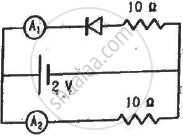
(Assume that the resistance of each diode is zero in forward bias and is infinity in reverse bias.)
Find the equivalent resistance of the network shown in figure between the points A and B.
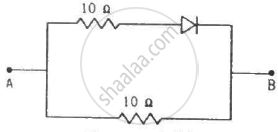
(Assume that the resistance of each diode is zero in forward bias and is infinity in reverse bias.)
A diode, a resistor and a 50 Hz AC source are connected in series. The number of current pulses per second through the resistor is __________ .
In a semiconductor diode, the barrier potential offers opposition to only ______.
The formation of the depletion region in a p-n junction diode is due to ______.
For an ideal diode, in forward and reverse biased condition the resistance is respectively ______.
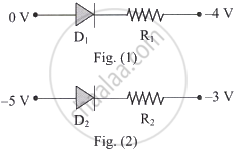
Diode and resistance are connected as shown in figure. Out of the following statements which one is TRUE?
What is dynamic resistance?
In which direction is the electric field established by the fixed ions?
In which circuits are diodes used for signal detection?
