Advertisements
Advertisements
Question
When a p-n junction is reverse-biased, the current becomes almost constant at 25 µA. When it is forward-biased at 200 mV, a current of 75 µA is obtained. Find the magnitude of diffusion current when the diode is
(a) unbiased,
(b) reverse-biased at 200 mV and
(c) forward-biased at 200 mV.
Advertisements
Solution
Given:
Drift current (current under reverse bias), i1 = 25 µA
Forward bias voltage, V = 200 mV
Net current under forward bias, i2 = 75 µA
(a) When the p‒n junction is in unbiased condition, no net current flows across the junction.
i.e. Drift current = Diffusion current
∴ Diffusion current = 25 µA
(b) Under reverse bias, the built in the potential and applied voltage opposes the motion of the majority carriers across the junction.
Thus, the diffusion current becomes zero.
(c) Under forward bias, the voltage supports the motion of majority carriers across the junction.
Let the actual current be x.
So,
(x − Drift current) = Forward-biassed current
\[\Rightarrow x - 25 \mu \text{ A }= 75 \mu \text{A}\]
\[ \Rightarrow x = (75 + 25) \mu \text{ A }\]
\[ \Rightarrow x = 100 \mu \text{ A }\]
APPEARS IN
RELATED QUESTIONS
Explain briefly with the help of necessary diagrams, the reverse biasing of a p-n junction diode. Also draw characteristic curves.
Mention the important considerations required while fabricating a p-n junction diode to be used as a Light Emitting Diode (LED). What should be the order of band gap of an LED if it is required to emit light in the visible range?
The drift current in a p-n junction is
Diffusion current in a p-n junction is greater than the drift current in magnitude
In a p-n junction, a potential barrier of 250 meV exists across the junction. A hole with a kinetic energy of 300 meV approaches the junction. Find the kinetic energy of the hole when it crosses the junction if the hole approached the junction (a) from the p-side and (b) from the n-side.
Consider a p-n junction diode having the characteristic \[i - i_0 ( e^{eV/kT} - 1) \text{ where } i_0 = 20\mu A\] . The diode is operated at T = 300 K . (a) Find the current through the diode when a voltage of 300 mV is applied across it in forward bias. (b) At what voltage does the current double?
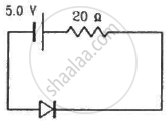
Calculate the current through the circuit and the potential difference across the diode shown in figure. The drift current for the diode is 20 µA.
What are the readings of the ammeters A1 and A2 shown in figure. Neglect the resistance of the meters.
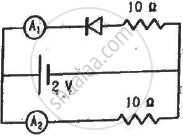
(Assume that the resistance of each diode is zero in forward bias and is infinity in reverse bias.)
Choose the correct option.
Current through a reverse-biased p-n junction increases abruptly at:
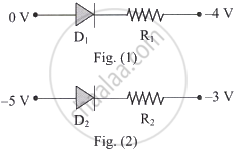
Diode and resistance are connected as shown in figure. Out of the following statements which one is TRUE?
What is a p-n junction diode?
Which process moves charge carriers from a higher concentration to a lower concentration?
In which direction is the electric field established by the fixed ions?
How does the interface between physically joined p-type and n-type slabs act on charge carriers?
How is a true p-n junction created instead of physically joining separate semiconductor pieces?
What is the use of diodes in power supplies and chargers?
In which circuits are diodes used for signal detection?
What is the net current in zero bias when diffusion and drift currents balance?
