Advertisements
Advertisements
प्रश्न
When a p-n junction is reverse-biased, the current becomes almost constant at 25 µA. When it is forward-biased at 200 mV, a current of 75 µA is obtained. Find the magnitude of diffusion current when the diode is
(a) unbiased,
(b) reverse-biased at 200 mV and
(c) forward-biased at 200 mV.
Advertisements
उत्तर
Given:
Drift current (current under reverse bias), i1 = 25 µA
Forward bias voltage, V = 200 mV
Net current under forward bias, i2 = 75 µA
(a) When the p‒n junction is in unbiased condition, no net current flows across the junction.
i.e. Drift current = Diffusion current
∴ Diffusion current = 25 µA
(b) Under reverse bias, the built in the potential and applied voltage opposes the motion of the majority carriers across the junction.
Thus, the diffusion current becomes zero.
(c) Under forward bias, the voltage supports the motion of majority carriers across the junction.
Let the actual current be x.
So,
(x − Drift current) = Forward-biassed current
\[\Rightarrow x - 25 \mu \text{ A }= 75 \mu \text{A}\]
\[ \Rightarrow x = (75 + 25) \mu \text{ A }\]
\[ \Rightarrow x = 100 \mu \text{ A }\]
APPEARS IN
संबंधित प्रश्न
Write the two processes that take place in the formation of a p-n junction.
Explain briefly with the help of necessary diagrams, the reverse biasing of a p-n junction diode. Also draw characteristic curves.
Draw a circuit diagram to study the input and output characteristics of an n-p-n transistor in its common emitter configuration. Draw the typical input and output characteristics.
How is a zener diode fabricated so as to make it a special purpose diode? Draw I-V characteristics of zener diode and explain the significance of breakdown voltage.
Explain briefly, with the help of a circuit diagram, how a p-n junction diode works as a half wave rectifier.
The diffusion current in a p-n junction is
Diffusion current in a p-n junction is greater than the drift current in magnitude
A hole diffuses from the p-side to the n-side in a p-n junction. This means that
A semiconducting device is connected in a series circuit with a battery and a resistance. A current is found to pass through the circuit. If the polarity of the battery is reversed, the current drops to almost zero. the device may be
(a) an intrinsic semiconductor
(b) a p-type semiconductor
(c) an n-type semiconductor
(d) a p-n junction
The drift current in a p-n junction is 20.0 µA. Estimate the number of electrons crossing a cross section per second in the depletion region.
The current−voltage characteristic of an ideal p-n junction diode is given by \[i = i_0 ( e^{eV/KT} - 1)\] where, the drift current i0 equals 10 µA. Take the temperature T to be 300 K. (a) Find the voltage V0 for which \[e^{eV/kT} = 100 .\]One can neglect the term 1 for voltages greater than this value. (b) Find an expression for the dynamic resistance of the diode as a function of V for V > V0. (c) Find the voltage for which the dynamic resistance is 0.2 Ω.
(Use Planck constant h = 4.14 × 10⁻¹⁵ eV-s, Boltzmann constant k = 8·62 × 10-5 eV/K.)
What are the readings of the ammeters A1 and A2 shown in figure. Neglect the resistance of the meters.
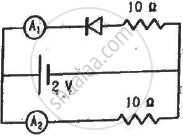
(Assume that the resistance of each diode is zero in forward bias and is infinity in reverse bias.)
Answer in detail.
Discuss the effect of external voltage on the width of depletion region of a p-n junction.
Zener breakdown occurs in a p-n junction having p and n both:
Diode and resistance are connected as shown in figure. Out of the following statements which one is TRUE?
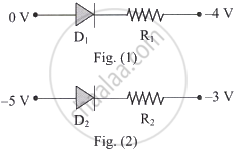
In p-n junction diode ______.
What is drift?
What is static resistance?
What is the approximate knee voltage for germanium?
Which formula gives the dynamic resistance of a diode?
