Advertisements
Advertisements
प्रश्न
A student wants to use two p-n junction diodes to convert alternating current into direct current. Draw the labelled circuit diagram she would use and explain how it works.
Advertisements
उत्तर
The student will use a full wave rectifier.
Two diodes are used to give rectified O/P corresponding to both positive as well as negative half cycles.
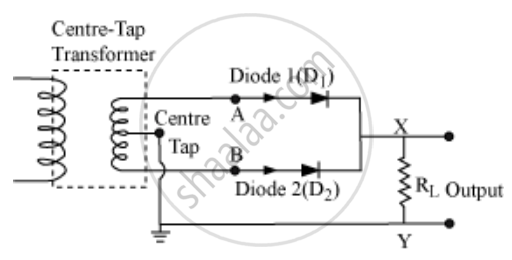
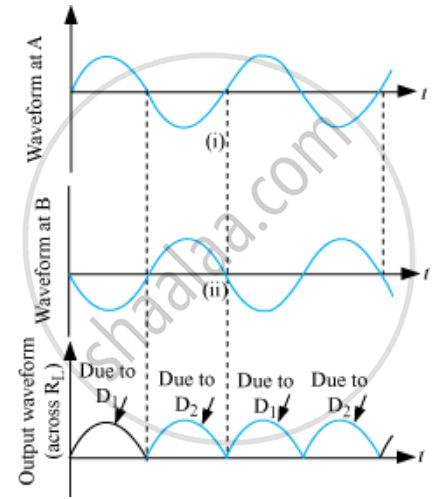
When the voltage at A with respect to the centre tap is positive, and the voltage at B is negative. Then, D1 is forward biased and D2 is reversed biased. Hence, D1 conducts and D2 does not.
When the voltage of A becomes negative, then B becomes + ve. Therefore, D1 does not conduct and D2 conducts. Hence, we obtain output voltage during both the positive as well as negative half of cycle.
APPEARS IN
संबंधित प्रश्न
Diffusion current in a p-n junction is greater than the drift current in magnitude
When a p-n junction is reverse-biased, the current becomes almost constant at 25 µA. When it is forward-biased at 200 mV, a current of 75 µA is obtained. Find the magnitude of diffusion current when the diode is
(a) unbiased,
(b) reverse-biased at 200 mV and
(c) forward-biased at 200 mV.
Find the currents through the resistance in the circuits shown in figure.
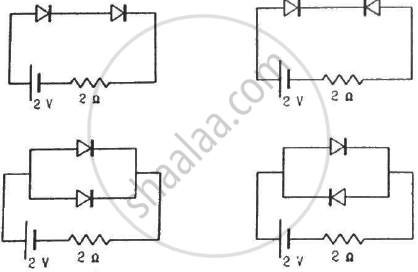
(Assume that the resistance of each diode is zero in forward bias and is infinity in reverse bias.)
Find the current through the resistance R in figure if (a) R = 12Ω (b) R = 48Ω.
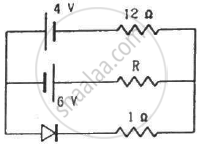
(Assume that the resistance of each diode is zero in forward bias and is infinity in reverse bias.)
A load resistor of 2kΩ is connected in the collector branch of an amplifier circuit using a transistor in common-emitter mode. The current gain β = 50. The input resistance of the transistor is 0.50 kΩ. If the input current is changed by 50µA. (a) by what amount does the output voltage change, (b) by what amount does the input voltage change and (c) what is the power gain?
p-n junction diode is formed
In p-n junction diode ______.
What is a p-n junction diode?
How is a true p-n junction created instead of physically joining separate semiconductor pieces?
What role do diodes perform in electronic switching?
