Advertisements
Advertisements
प्रश्न
The drift current in a p-n junction is 20.0 µA. Estimate the number of electrons crossing a cross section per second in the depletion region.
Advertisements
उत्तर
Given:
Drift current, id = 20 µA = 20 × 10−6 A
Both holes and electrons are moving and contributing to the current flow.
We know that current is the rate of the flow of charge.
Thus, we need to find the number of electrons crossing unit area per second.
Now,
t = 1 s
\[i_d = \frac{Q}{T}\]
\[ \because T = 1 \]s
\[ \therefore i_d = Q = \]ne
\[ \Rightarrow n = \frac{i_d}{e}\]
So, the total number of charge carriers crossing the depletion region is given by
\[n = \frac{20 \times {10}^{- 6}}{2 \times 1 . 6 \times {10}^{- 19}}\]
\[ \Rightarrow n = 6 . 25 \times {10}^{13}\]
Also, the number of electrons crossing the depletion region is given by
\[n_e = \frac{n}{2} = \frac{6 . 25 \times {10}^{13}}{2}\]
\[ \Rightarrow n_e = 3 . 1 \times {10}^{13}\]
APPEARS IN
संबंधित प्रश्न
In an unbiased p-n junction, holes diffuse from the p-region to n-region because ______.
In a p-n junction diode, the current I can be expressed as
I = `"I"_0 exp ("eV"/(2"k"_"BT") - 1)`
where I0 is called the reverse saturation current, V is the voltage across the diode and is positive for forward bias and negative for reverse bias, and I is the current through the diode, kBis the Boltzmann constant (8.6×10⁻⁵ eV/K) and T is the absolute temperature. If for a given diode I0 = 5 × 10⁻¹² A and T = 300 K, then
(a) What will be the forward current at a forward voltage of 0.6 V?
(b) What will be the increase in the current if the voltage across the diode is increased to 0.7 V?
(c) What is the dynamic resistance?
(d) What will be the current if reverse bias voltage changes from 1 V to 2 V?
Explain briefly with the help of necessary diagrams, the forward biasing of a p-n junction diode. Also draw characteristic curves.
Explain briefly with the help of necessary diagrams, the reverse biasing of a p-n junction diode. Also draw characteristic curves.
How is a zener diode fabricated so as to make it a special purpose diode? Draw I-V characteristics of zener diode and explain the significance of breakdown voltage.
Explain briefly, with the help of a circuit diagram, how a p-n junction diode works as a half wave rectifier.
The drift current in a reverse-biased p-n junction is increased in magnitude if the temperature of the junction is increased. Explain this on the basis of creation of hole-electron pairs.
If the two ends of a p-n junction are joined by a wire,
The diffusion current in a p-n junction is
Two identical p-n junction may be connected in series with a battery in three ways. The potential difference across the two p-n junctions are equal in

In a p-n junction with open ends,
(a) there is no systematic motion of charge carries
(b) holes and conduction electrons systematically go from the p-side to n-side and from the n-side to p-side respectively
(c) there is no net charge transfer between the two sides
(d) there is a constant electric field near the junction.
In a p-n junction,
(a) new holes and conduction electrons are produced continuously throughout the material
(b) new holes and conduction electrons are produced continuously throughout the material except in the depletion region
(c) holes and conduction electrons recombine continuously throughout the material
(d) holes and conduction electrons recombine continuously throughout the material except in the depletion region.
When a p-n junction is reverse-biased, the current becomes almost constant at 25 µA. When it is forward-biased at 200 mV, a current of 75 µA is obtained. Find the magnitude of diffusion current when the diode is
(a) unbiased,
(b) reverse-biased at 200 mV and
(c) forward-biased at 200 mV.
Find the currents through the resistance in the circuits shown in figure.
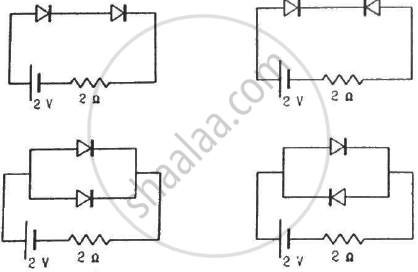
(Assume that the resistance of each diode is zero in forward bias and is infinity in reverse bias.)
An AC source is connected to a diode and a resistor in series. Is the current thorough the resistor AC or DC?
If in a p-n junction diode, a square input signal of 10 V is applied as shown Then the output signal across RL will be ______

The depletion layer in the p-n junction diode is caused by ______.
In a semiconductor diode, the barrier potential offers opposition to only ______.
During the formation of a p-n junction ______.
Diode and resistance are connected as shown in figure. Out of the following statements which one is TRUE?