Advertisements
Advertisements
प्रश्न
Mention the important considerations required while fabricating a p-n junction diode to be used as a Light Emitting Diode (LED). What should be the order of band gap of an LED if it is required to emit light in the visible range?
Advertisements
उत्तर
1. The reverse breakdown voltages of LEDs are very low, typically around 5V. So care should be taken while fabricating a pn-junction diode so that the high reverse voltages do not appear across them.
2. There is very little resistance to limit the current in LED. Therefore, a resistor must be used in series with the LED to avoid any damage to it.
The semiconductor used for fabrication of visible LEDs must at least have a band gap of 1.8 eV (spectral range of visible light is from about 0.4 μm to 0.7 μm, i.e., from about 3 eV to 1.8 eV).
APPEARS IN
संबंधित प्रश्न
Explain briefly with the help of necessary diagrams, the forward biasing of a p-n junction diode. Also draw characteristic curves.
A hole diffuses from the p-side to the n-side in a p-n junction. This means that
In a p-n junction, a potential barrier of 250 meV exists across the junction. A hole with a kinetic energy of 300 meV approaches the junction. Find the kinetic energy of the hole when it crosses the junction if the hole approached the junction (a) from the p-side and (b) from the n-side.
Consider a p-n junction diode having the characteristic \[i - i_0 ( e^{eV/kT} - 1) \text{ where } i_0 = 20\mu A\] . The diode is operated at T = 300 K . (a) Find the current through the diode when a voltage of 300 mV is applied across it in forward bias. (b) At what voltage does the current double?
What are the readings of the ammeters A1 and A2 shown in figure. Neglect the resistance of the meters.
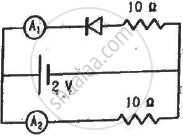
(Assume that the resistance of each diode is zero in forward bias and is infinity in reverse bias.)
Find the equivalent resistance of the network shown in figure between the points A and B.
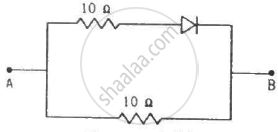
(Assume that the resistance of each diode is zero in forward bias and is infinity in reverse bias.)
In p-n junction diode ______.
What is drift?
In which direction is the electric field established by the fixed ions?
Which formula gives the dynamic resistance of a diode?
