Advertisements
Advertisements
प्रश्न
In a p-n junction diode, the current I can be expressed as
I = `"I"_0 exp ("eV"/(2"k"_"BT") - 1)`
where I0 is called the reverse saturation current, V is the voltage across the diode and is positive for forward bias and negative for reverse bias, and I is the current through the diode, kBis the Boltzmann constant (8.6×10⁻⁵ eV/K) and T is the absolute temperature. If for a given diode I0 = 5 × 10⁻¹² A and T = 300 K, then
(a) What will be the forward current at a forward voltage of 0.6 V?
(b) What will be the increase in the current if the voltage across the diode is increased to 0.7 V?
(c) What is the dynamic resistance?
(d) What will be the current if reverse bias voltage changes from 1 V to 2 V?
Advertisements
उत्तर
a) In a p-n junction diode, the expression for current is given as:
I = `"I"_0 exp("eV"/(2"k"_"B" "T") - 1)`
Where,
I0 = Reverse saturation current = 5 × 10⁻¹² A
T = Absolute temperature = 300 K
kB = Boltzmann constant = 8.6 × 10⁻⁵ eV/K = 1.376 × 10⁻²³ J K−1
V = Voltage across the diode
(a) Forward voltage, V = 0.6 V
= `5 xx 10^(-12)[exp ((1.6xx 10^(-19) xx 0.6)/(1.376 xx 10^(-23) xx 300))-1]`
∴ Current, I
`= 5 xx 10^(-12) xx exp [22.36] = 0.0256 A`
Therefore, the forward current is about 0.0256 A.
(b) For forward voltage, V’ = 0.7 V, we can write:
I' =`5 xx 10^(-12) [exp ((1.6 xx 10^(-19) xx 0.7)/(1.376 xx 10^(-23) xx 300)) - 1]`
`= 5 xx 10^(-12) xx exp [26.25] = 1.257` A
Hence, the increase in current, ΔI = I' − I
= 1.257 − 0.0256 = 1.23 A
(c) Dynamic resistance = `"Change in voltage"/"Change in Current"`
`= (0.7 - 0.6)/1.23 = 0.1/1.23 = 0.081 "Ω"`
(d) If the reverse bias voltage changes from 1 V to 2 V, then the current (I) will almost remain equal to I0 in both cases. Therefore, the dynamic resistance in the reverse bias will be infinite.
संबंधित प्रश्न
Write the two processes that take place in the formation of a p-n junction.
A student wants to use two p-n junction diodes to convert alternating current into direct current. Draw the labelled circuit diagram she would use and explain how it works.
Explain, with the help of a circuit diagram, the working of a photo-diode. Write briefly how it is used to detect the optical signals.
Mention the important considerations required while fabricating a p-n junction diode to be used as a Light Emitting Diode (LED). What should be the order of band gap of an LED if it is required to emit light in the visible range?
Explain, with the help of a circuit diagram, the working of n-p-n transistor as a common emitter amplifier.
If the two ends of a p-n junction are joined by a wire,
The current−voltage characteristic of an ideal p-n junction diode is given by \[i = i_0 ( e^{eV/KT} - 1)\] where, the drift current i0 equals 10 µA. Take the temperature T to be 300 K. (a) Find the voltage V0 for which \[e^{eV/kT} = 100 .\]One can neglect the term 1 for voltages greater than this value. (b) Find an expression for the dynamic resistance of the diode as a function of V for V > V0. (c) Find the voltage for which the dynamic resistance is 0.2 Ω.
(Use Planck constant h = 4.14 × 10⁻¹⁵ eV-s, Boltzmann constant k = 8·62 × 10-5 eV/K.)
Find the current through the resistance R in figure if (a) R = 12Ω (b) R = 48Ω.
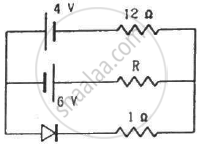
(Assume that the resistance of each diode is zero in forward bias and is infinity in reverse bias.)
Choose the correct option.
Current through a reverse-biased p-n junction increases abruptly at:
If in a p-n junction diode, a square input signal of 10 V is applied as shown Then the output signal across RL will be ______

In a semiconductor diode, the barrier potential offers opposition to only ______.
p-n junction diode is formed
The formation of the depletion region in a p-n junction diode is due to ______.
During the formation of a p-n junction ______.
What is a p-n junction diode?
What is static resistance?
What role do diodes perform in electronic switching?
What is the approximate knee voltage for silicon?
Which formula gives the dynamic resistance of a diode?
