Advertisements
Advertisements
प्रश्न
Find the equivalent resistance of the network shown in figure between the points A and B.
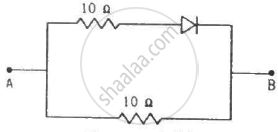
(Assume that the resistance of each diode is zero in forward bias and is infinity in reverse bias.)
Advertisements
उत्तर
Let the potentials at A and B be VA and VB, respectively.
(i) When VA > VB, that is, a battery is connected between points A and B, with its positive terminal connected to point A and its negative terminal connected to point B:
As the potential on the p-side of the diode is greater than the potential on the n-side of the diode, the diode is forward biased; thus, it can be replaced by a short circuit.
As the two resistances are connected in parallel, the effective resistance becomes
Equivalent resistance \[= \frac{10}{2} = 5 \Omega\]
(ii) When VA < VB:
The diode is reverse biased, so it is replaced by an open circuit. Thus, no current flows through this branch.
∴ Equivalent resistance = 10 Ω
APPEARS IN
संबंधित प्रश्न
In an unbiased p-n junction, holes diffuse from the p-region to n-region because ______.
Explain briefly with the help of necessary diagrams, the reverse biasing of a p-n junction diode. Also draw characteristic curves.
A student wants to use two p-n junction diodes to convert alternating current into direct current. Draw the labelled circuit diagram she would use and explain how it works.
Explain, with the help of a circuit diagram, the working of a photo-diode. Write briefly how it is used to detect the optical signals.
Mention the important considerations required while fabricating a p-n junction diode to be used as a Light Emitting Diode (LED). What should be the order of band gap of an LED if it is required to emit light in the visible range?
The drift current in a reverse-biased p-n junction is increased in magnitude if the temperature of the junction is increased. Explain this on the basis of creation of hole-electron pairs.
Two identical p-n junction may be connected in series with a battery in three ways. The potential difference across the two p-n junctions are equal in

In a p-n junction with open ends,
(a) there is no systematic motion of charge carries
(b) holes and conduction electrons systematically go from the p-side to n-side and from the n-side to p-side respectively
(c) there is no net charge transfer between the two sides
(d) there is a constant electric field near the junction.
The potential barrier existing across an unbiased p-n junction is 0.2 volt. What minimum kinetic energy a hole should have to diffuse from the p-side to the n-side if (a) the junction is unbiased, (b) the junction is forward-biased at 0.1 volt and (c) the junction is reverse-biased at 0.1 volt?
Consider a p-n junction diode having the characteristic \[i - i_0 ( e^{eV/kT} - 1) \text{ where } i_0 = 20\mu A\] . The diode is operated at T = 300 K . (a) Find the current through the diode when a voltage of 300 mV is applied across it in forward bias. (b) At what voltage does the current double?
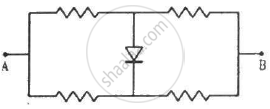
Each of the resistance shown in figure has a value of 20 Ω. Find the equivalent resistance between A and B. Does it depend on whether the point A or B is at higher potential?
Find the current through the battery in each of the circuits shown in figure.
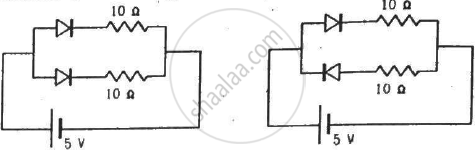
(Assume that the resistance of each diode is zero in forward bias and is infinity in reverse bias.)
Draw the current-voltage characteristics for the device show in figure between the terminals A and B.
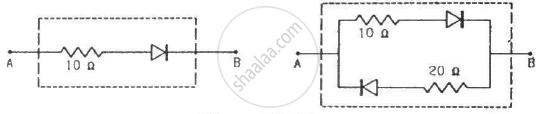
(Assume that the resistance of each diode is zero in forward bias and is infinity in reverse bias.)
When the base current in a transistor is changed from 30µA to 80µA, the collector current is changed from 1.0 mA to 3.5 mA. Find the current gain β.
If in a p-n junction diode, a square input signal of 10 V is applied as shown Then the output signal across RL will be ______

Diode and resistance are connected as shown in figure. Out of the following statements which one is TRUE?
What is barrier potential?
In which direction is the electric field established by the fixed ions?
Which formula gives the static resistance of a diode?
