Advertisements
Advertisements
Question
A load resistor of 2kΩ is connected in the collector branch of an amplifier circuit using a transistor in common-emitter mode. The current gain β = 50. The input resistance of the transistor is 0.50 kΩ. If the input current is changed by 50µA. (a) by what amount does the output voltage change, (b) by what amount does the input voltage change and (c) what is the power gain?
Advertisements
Solution
Given:
Base current gain, \[\beta = 50\]
Change in base current, \[\delta I_b = 50 \mu A\]
Load resistance, \[R_L\] = 2 kΩ
Input resistance, \[R_i\] = 0.50 kΩ
(a) The change in output voltage is given by
\[V_0 = I_c \times R_L \]
\[ \because I_c = \beta \times I_b \]
\[ \therefore V_0 = \beta \times I_b \times R_L \]
\[ \Rightarrow V_0 = 50 \times 50 \mu A \times 2 k\Omega\]
\[ \Rightarrow V_0 = 5 V\]
(b) The change in input voltage is given by
\[\delta V_i = \delta l_b \times R_i \]
\[ \Rightarrow \delta V_i = 50 \times {10}^{- 6} \times 5 \times {10}^2 \]
\[ \Rightarrow \delta V_i = 25 \times {10}^{- 3} \]
\[ \Rightarrow \delta V_i = 25 \text{ mV}\]
(c) Power gain is given by
\[\beta^2 \times \frac{R_L}{R_i}\]
\[ \Rightarrow 2500 \times \frac{2}{0 . 5}\]
\[ \Rightarrow 2500 \times \frac{20}{5} = {10}^4\]
APPEARS IN
RELATED QUESTIONS
In an unbiased p-n junction, holes diffuse from the p-region to n-region because ______.
In a p-n junction diode, the current I can be expressed as
I = `"I"_0 exp ("eV"/(2"k"_"BT") - 1)`
where I0 is called the reverse saturation current, V is the voltage across the diode and is positive for forward bias and negative for reverse bias, and I is the current through the diode, kBis the Boltzmann constant (8.6×10⁻⁵ eV/K) and T is the absolute temperature. If for a given diode I0 = 5 × 10⁻¹² A and T = 300 K, then
(a) What will be the forward current at a forward voltage of 0.6 V?
(b) What will be the increase in the current if the voltage across the diode is increased to 0.7 V?
(c) What is the dynamic resistance?
(d) What will be the current if reverse bias voltage changes from 1 V to 2 V?
The drift current in a reverse-biased p-n junction is increased in magnitude if the temperature of the junction is increased. Explain this on the basis of creation of hole-electron pairs.
If the two ends of a p-n junction are joined by a wire,
The potential barrier existing across an unbiased p-n junction is 0.2 volt. What minimum kinetic energy a hole should have to diffuse from the p-side to the n-side if (a) the junction is unbiased, (b) the junction is forward-biased at 0.1 volt and (c) the junction is reverse-biased at 0.1 volt?
The drift current in a p-n junction is 20.0 µA. Estimate the number of electrons crossing a cross section per second in the depletion region.
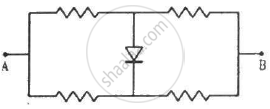
Each of the resistance shown in figure has a value of 20 Ω. Find the equivalent resistance between A and B. Does it depend on whether the point A or B is at higher potential?
What are the readings of the ammeters A1 and A2 shown in figure. Neglect the resistance of the meters.
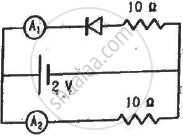
(Assume that the resistance of each diode is zero in forward bias and is infinity in reverse bias.)
Find the current through the battery in each of the circuits shown in figure.
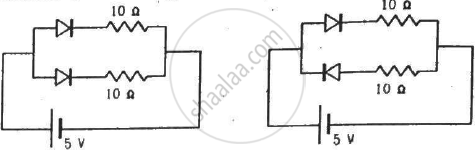
(Assume that the resistance of each diode is zero in forward bias and is infinity in reverse bias.)
Find the current through the resistance R in figure if (a) R = 12Ω (b) R = 48Ω.
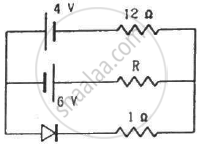
(Assume that the resistance of each diode is zero in forward bias and is infinity in reverse bias.)
Draw the current-voltage characteristics for the device show in figure between the terminals A and B.
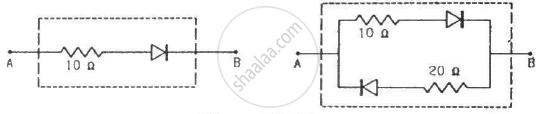
(Assume that the resistance of each diode is zero in forward bias and is infinity in reverse bias.)
An AC source is connected to a diode and a resistor in series. Is the current thorough the resistor AC or DC?
In a semiconductor diode, the barrier potential offers opposition to only ______.
During the formation of a p-n junction ______.
Diode and resistance are connected as shown in figure. Out of the following statements which one is TRUE?
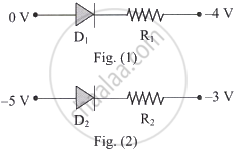
What is the depletion region?
What is drift?
Which charge carriers remain near the junction after the region loses mobile charge carriers?
In which direction is the electric field established by the fixed ions?
