Advertisements
Advertisements
Question
A semiconducting device is connected in a series circuit with a battery and a resistance. A current is found to pass through the circuit. If the polarity of the battery is reversed, the current drops to almost zero. the device may be
(a) an intrinsic semiconductor
(b) a p-type semiconductor
(c) an n-type semiconductor
(d) a p-n junction
Advertisements
Solution
a p−n junction
As a p−n junction allows the flow of current in forward bias and stops the current in reverse bias (almost negligible reverse leakage current flows in the reverse-biassed p−njunction), the device should be a p−n junction. Other options are examples of semiconductors that allow moderate current to flow and that do not have any effect of changing the polarity of the battery.
APPEARS IN
RELATED QUESTIONS
Explain briefly with the help of necessary diagrams, the forward biasing of a p-n junction diode. Also draw characteristic curves.
A student wants to use two p-n junction diodes to convert alternating current into direct current. Draw the labelled circuit diagram she would use and explain how it works.
How is a zener diode fabricated so as to make it a special purpose diode? Draw I-V characteristics of zener diode and explain the significance of breakdown voltage.
Explain briefly, with the help of a circuit diagram, how a p-n junction diode works as a half wave rectifier.
A hole diffuses from the p-side to the n-side in a p-n junction. This means that
In a p-n junction, a potential barrier of 250 meV exists across the junction. A hole with a kinetic energy of 300 meV approaches the junction. Find the kinetic energy of the hole when it crosses the junction if the hole approached the junction (a) from the p-side and (b) from the n-side.
Consider a p-n junction diode having the characteristic \[i - i_0 ( e^{eV/kT} - 1) \text{ where } i_0 = 20\mu A\] . The diode is operated at T = 300 K . (a) Find the current through the diode when a voltage of 300 mV is applied across it in forward bias. (b) At what voltage does the current double?
Each of the resistance shown in figure has a value of 20 Ω. Find the equivalent resistance between A and B. Does it depend on whether the point A or B is at higher potential?
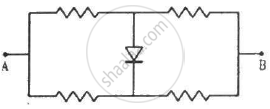
Find the equivalent resistance of the network shown in figure between the points A and B.
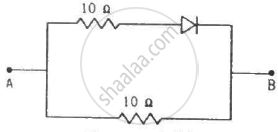
(Assume that the resistance of each diode is zero in forward bias and is infinity in reverse bias.)
An AC source is connected to a diode and a resistor in series. Is the current thorough the resistor AC or DC?
If in a p-n junction diode, a square input signal of 10 V is applied as shown Then the output signal across RL will be ______

The formation of the depletion region in a p-n junction diode is due to ______.
What is the depletion region?
What is a p-n junction diode?
What is dynamic resistance?
When p-type and n-type regions are formed in a single crystal, which carriers initially diffuse from each side?
Why does microscopic roughness prevent a proper crystal lattice from forming between separate p-type and n-type slabs?
How is a true p-n junction created instead of physically joining separate semiconductor pieces?
What is the approximate knee voltage for germanium?
