Advertisements
Advertisements
प्रश्न
Explain briefly with the help of necessary diagrams, the forward biasing of a p-n junction diode. Also draw characteristic curves.
Advertisements
उत्तर
p-n junction diode under forward bias

p-side is connected to positive terminal and n-side to the negative terminal.
Applied voltage drops across the depletion region.
Direction of applied voltage (V) is opposite to the build in potential (V0).
As the depletion layer width decreases, the barrier height is reduced.
Effective barrier height under forward bias is (V0 − V).
-
Electron in n-region moves towards the p-n junction and holes in p-region move towards the junction. The width of the depletion layer decreases and hence, it offers less resistance.
-
Diffusion of majority carriers takes place across the junction.
This leads to forward current.
APPEARS IN
संबंधित प्रश्न
In an unbiased p-n junction, holes diffuse from the p-region to n-region because ______.
The drift current in a reverse-biased p-n junction is increased in magnitude if the temperature of the junction is increased. Explain this on the basis of creation of hole-electron pairs.
A load resistor of 2kΩ is connected in the collector branch of an amplifier circuit using a transistor in common-emitter mode. The current gain β = 50. The input resistance of the transistor is 0.50 kΩ. If the input current is changed by 50µA. (a) by what amount does the output voltage change, (b) by what amount does the input voltage change and (c) what is the power gain?
An AC source is connected to a diode and a resistor in series. Is the current thorough the resistor AC or DC?
Choose the correct option.
Current through a reverse-biased p-n junction increases abruptly at:
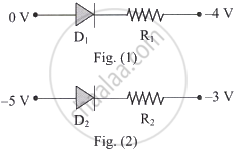
Diode and resistance are connected as shown in figure. Out of the following statements which one is TRUE?
In p-n junction diode ______.
When p-type and n-type regions are formed in a single crystal, which carriers initially diffuse from each side?
How does the interface between physically joined p-type and n-type slabs act on charge carriers?
What is the use of diodes in power supplies and chargers?
