Advertisements
Advertisements
Question
The diagram shows the four energy levels of an electron in the Bohr model of the hydrogen atom. Identify the transition in which the emitted photon will have the highest energy.

Options
I
II
III
IV
Advertisements
Solution
I
Explanation:
The correct scale is used to create the energy diagram, which displays the various energy levels.
The largest energy difference occurs during the change from state 3 to state 1. The first jump would be the most energetic and provide the strongest photon emission.
APPEARS IN
RELATED QUESTIONS
The ground state energy of a hydrogen atom is −13.6 eV. What are the kinetic and potential energies of the electron in this state?
What are means by pair annihilation? Write a balanced equation for the same.
A 12.9 eV beam of electronic is used to bombard gaseous hydrogen at room temperature. Upto which energy level the hydrogen atoms would be excited ?
Calculate the wavelength of the first member of Paschen series and first member of Balmer series.
A Carnot engine absorbs 1000 J of heat energy from a reservoir at 127°C and rejects 600 J of heat energy during each cycle. The efficiency of the engine and temperature of the sink will be:
The Ionisation energy of hydrogen atom is 3.6 ev The ionisation energy of helium atom would be
Energy of an electron at infinity from nucleus is ______.
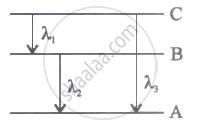
Energy levels A, B, C of acertain atom corresponding to increasing value of energy, i.e., EA< E8 < Ee. If λ1, λ2 and λ3 are the wavelength of radiations corresponding to the transitions C to B, B to A and C to A respectively, which of the following statements is correct?
Radiation coming from transitions n = 2 to n = 1 of hydrogen atoms fall on He+ ions in n = 1 and n = 2 states. The possible transition of helium ions as they absorb energy from the radiation is ______.
Which state corresponds to the lowest energy of the hydrogen atom?
What can happen when a hydrogen atom absorbs energy?
