Advertisements
Advertisements
प्रश्न
In Young's double-slit experiment, the screen is moved away from the plane of the slits. What will be its effect on the following?
- The angular separation of the fringes.
- Fringe-width.
विकल्प
Both (i) and (ii) remain constant.
(i) remains constant, but (ii) decreases.
(i) remains constant, but (ii) increases.
Both (i) and (ii) increase.
Advertisements
उत्तर
(i) remains constant, but (ii) increases.
Explanation:
When the screen is moved away 'D' increases and we know `beta = (lambdaD)/d`
So, if D increases, fringe-width (β) also increases and angular separation `(lambda/d)` remains the same.
APPEARS IN
संबंधित प्रश्न
In a Young’s double-slit experiment, the slits are separated by 0.28 mm and the screen is placed 1.4 m away. The distance between the central bright fringe and the fourth bright fringe is measured to be 1.2 cm. Determine the wavelength of light used in the experiment.
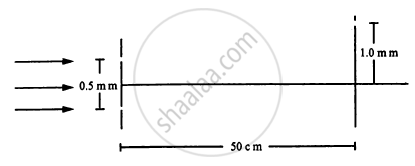
White coherent light (400 nm-700 nm) is sent through the slits of a Young's double slit experiment (see the following figure). The separation between the slits is 0⋅5 mm and the screen is 50 cm away from the slits. There is a hole in the screen at a point 1⋅0 mm away (along the width of the fringes) from the central line. (a) Which wavelength(s) will be absent in the light coming from the hole? (b) Which wavelength(s) will have a strong intensity?
In a Young's double slit interference experiment, the fringe pattern is observed on a screen placed at a distance D from the slits. The slits are separated by a distance d and are illuminated by monochromatic light of wavelength \[\lambda.\] Find the distance from the central point where the intensity falls to (a) half the maximum, (b) one-fourth the maximum.
In Young’s double-slit experiment, show that:
`beta = (lambda "D")/"d"` where the terms have their usual meaning.
When a beam of light is used to determine the position of an object, the maximum accuracy is achieved, if the light is ______.
How will the interference pattern in Young's double-slit experiment be affected if the source slit is moved away from the plane of the slits?
In an interference experiment, a third bright fringe is obtained at a point on the screen with a light of 700 nm. What should be the wavelength of the light source in order to obtain the fifth bright fringe at the same point?
In Young's double slit experiment, show that:
`β = (λ"D")/"d"`
Where the terms have their usual meaning.
What does \(x\) denote when deriving fringe positions?
What happens to fringe width when the screen distance increases while wavelength and slit separation remain unchanged?
