Advertisements
Advertisements
प्रश्न
Use Huygens’s principle to explain the formation of diffraction pattern due to a single slit illuminated by a monochromatic source of light.
Advertisements
उत्तर
Consider a parallel beam of monochromatic light is incident normally in a slit of width b as shown if figure. According to Huygens’s principle every point of slit acts as a source of secondary wavelets spreading in all directions. Screen is placed at a larger distance.
Consider a particular point P on the screen receives waves from all the secondary sources. All these waves start from different point of the slit and interface at point P to give
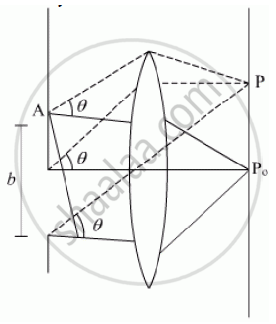
Point P0 is at bisector plane of the slit. At P0, all waves are traveling equal optical path. So are in phase the waves thus interface constructively with each other and maximum intensity is observed. As we move from P0, the wave arrives with different phase and intensity is changed. Intensity at point P is given by
`I = I_0 (sin^2α)/alpha`
where `alpha = pi/lambda b sin theta`
For central maxima α = 0 thus,
I = I0
APPEARS IN
संबंधित प्रश्न
What is the shape of the wavefront in the following case?
The portion of the wavefront of light from a distant star was intercepted by the Earth.
Using Huygens’ principle, verify the laws of reflection at a plane surface.
Answer the following question.
Define the term wavefront. Using Huygen's wave theory, verify the law of reflection.
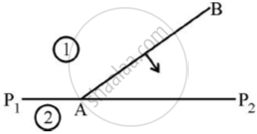
A plane wave front AB propagating from denser medium (1) into a rarer medium (2) is incident on the surface P1P2 separating the two media as shown in fig.
Using Huygen’s principle, draw the secondary wavelets and obtain the refracted wave front in the diagram.
According to Huygens’s principle, the amplitude of secondary wavelets is ______.
What did Christiaan Huygens explain in addition to reflection and refraction?
What happens when a small stone is dropped on a calm pool of water?
In Huygens' principle, what does each point of the wavefront act as?
What are the wavelets emanating from points on a wavefront called?
What shortcoming does Huygens' model have?
