हिंदी

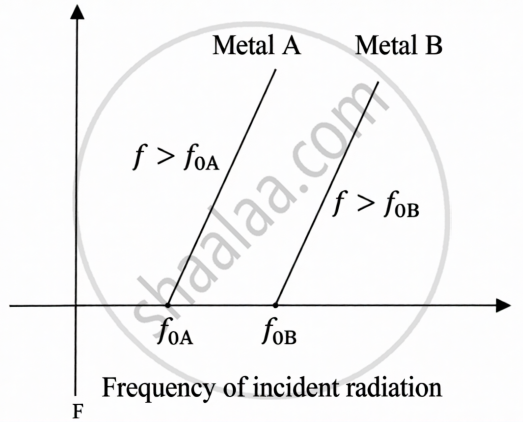
The graphs below show the variation of stopping potential versus frequency of incident radiation for metals A and B. UV radiation of appropriate wavelength is allowed to fall on both the metals. - Physics (Theory)
Advertisements
Advertisements

प्रश्न

The graphs below show the variation of stopping potential versus frequency of incident radiation for metals A and B. 

UV radiation of appropriate wavelength is allowed to fall on both the metals. Which metal will emit photoelectrons with higher maximum kinetic energy (Emax)? Give a reason.

कारण बताइए
Advertisements

उत्तर

  1. From the graph, the threshold frequency of Metal A is lower than that of Metal B.
  2. Since work function is given by Φ=hf0\Phi = hf_0Φ = h f0​, Metal A has a smaller work function than Metal B.
  3. According to Einstein’s photoelectric equation, Kmax = hf − Φ.
  4. The incident radiation is the same for both metals, so the value of hfhfhf remains constant.
  5. As Metal A has a smaller work function, the value of Kmax​ will be greater for Metal A.

Therefore, Metal A emits photoelectrons with higher maximum ki netic energy.

  •  

Based on the graph and Einstein’s photoelectric equation, here is the solution Metal A will emit photoelectrons with higher maximum kinetic energy (Kmax).


  1. Threshold Frequency (f0): The graph shows that the threshold frequency for Metal A (f0A) is lower than that for Metal B (f0B).
  2. Work Function (Φ): The work function is directly proportional to the threshold frequency (Φ = h f0). Since f0A < f0B, Metal A has a smaller work function than Metal B.
  3. Einstein’s Equation: According to the formula Kmax = hf − Φ, the maximum kinetic energy is the energy of the incident light minus the work function.
  4. Constant Energy (hf): Since the incident UV radiation is the same for both metals, the metal with the smaller work function (Metal A) leaves more energy available for kinetic motion.

Therefore, Metal A results in a higher Kmax for its emitted photoelectrons.

shaalaa.com
  क्या इस प्रश्न या उत्तर में कोई त्रुटि है?
2025-2026 (March) Official Board Paper
Share
Notifications

Englishहिंदीमराठी


      Forgot password?
Use app×